Apple’s New Mac Mini Gets M6 Power — but the $899 Starting Price Changes the Story
Table of Contents
Apple’s New Mac Mini Gets M6 Power — but the $899 Starting Price Changes the Story
Apple has officially refreshed the Mac mini, introducing the new M6 chip alongside a more powerful M5 Pro option.
The compact desktop keeps the same tiny design introduced in 2024, but the internals have received a major upgrade. Apple is promising substantially faster CPU, graphics, storage, and AI performance, along with newer connectivity such as Wi-Fi 7, Bluetooth 6, and faster Ethernet.
There is one major catch: price.
The new M6 Mac mini starts at $899, while the M5 Pro version starts at $1,699. That makes the Mac mini significantly more expensive than the affordable desktop many users associated with the product.
Key Takeaways
- Apple has launched new Mac mini models with M6 and M5 Pro chips.
- The M6 marks Apple’s first move to advanced 2nm chip technology.
- The base M6 includes a 12-core CPU and 12-core GPU.
- Apple claims up to 40% faster CPU performance compared with M4.
- AI performance can be up to 4x faster, according to Apple.
- Storage performance is up to twice as fast.
- Wi-Fi 7, Bluetooth 6, and 2.5Gb Ethernet are now included.
- The M6 Mac mini starts at $899.
- The M5 Pro Mac mini starts at $1,699.
- Preorders are open, with availability beginning September 22, 2026.
What’s New With the 2026 Mac Mini?
The biggest change is inside.
Apple has replaced the previous M4 generation with its new M6 processor, while customers needing more performance can choose the M5 Pro.
Interestingly, Apple skipped a standard M5 Mac mini and moved the mainstream model directly from M4 to M6.
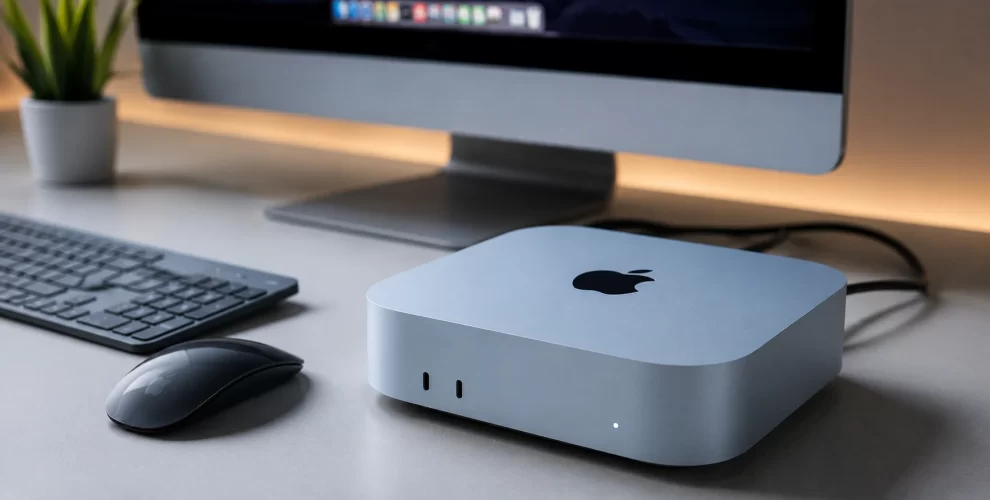
The exterior remains largely unchanged. Apple’s current Mac mini measures just 5 inches by 5 inches, maintaining the extremely compact design introduced with the previous generation.
So this isn’t a redesign.
It’s primarily a performance and connectivity upgrade.
What Is Apple’s New M6 Chip?
M6 is Apple’s latest generation of in-house silicon and the company’s first 2-nanometer chip.
The standard Mac mini configuration features:
12-core CPU
12-core GPU
16GB unified memory
256GB SSD storage
Apple says the M6 delivers up to 40% faster CPU performance and twice the graphics performance compared with the M4 generation.
The chip also increases memory bandwidth to 170GB/s.
Those improvements should benefit everyday workloads, creative applications, development, and increasingly important local AI tasks.
Why Is Apple Focusing So Much on AI?
AI is becoming one of the main selling points for Apple’s latest Mac hardware.
The M6 incorporates Neural Accelerators into its GPU cores, alongside Apple’s Neural Engine.
Apple says the new Mac mini can deliver up to four times faster AI performance than its predecessor.
That matters as more AI workloads move directly onto personal computers rather than relying entirely on cloud servers.
Local models, coding agents, image processing, video enhancement, and other AI applications can benefit from faster on-device processing.
Reuters reports that Apple’s latest desktop lineup is specifically targeting growing demand for local AI computing.
How Powerful Is the M5 Pro Mac Mini?
Users needing considerably more performance can move to the M5 Pro Mac mini.
The higher-end configuration can offer up to:
18 CPU cores
20 GPU cores
64GB unified memory
307GB/s memory bandwidth
It also includes Neural Accelerators designed to improve AI workloads.
This model is aimed more directly at developers, video professionals, designers, and users running demanding local AI models.
M6 vs. M5 Pro: What’s the Difference?
The M6 Mac mini is designed for users who want strong everyday performance, faster AI processing, and improved efficiency in a compact desktop.
It comes with a 12-core CPU, 12-core GPU, and 170GB/s memory bandwidth. It is best suited for general productivity, development, creative work, and local AI tasks that do not require the highest-end hardware.
The M5 Pro Mac mini is the more powerful option. It can be configured with up to 18 CPU cores, 20 GPU cores, and 307GB/s memory bandwidth.
It is better suited for demanding professional workloads such as large software projects, video editing, 3D work, and heavier AI processing.
Pricing begins at $899 for the M6 Mac mini and $1,699 for the more powerful M5 Pro model.
So the simple difference is this: M6 focuses on newer architecture and efficiency, while M5 Pro gives you more raw performance for professional workloads.
Did Apple Improve the Mac Mini’s Storage?
Yes.
Apple says storage performance is now up to twice as fast on the new generation.
That’s useful because storage speed affects much more than copying files.
Faster storage can improve application loading, large project workflows, video editing, data processing, and tasks that need to move large amounts of information between storage and memory.
It should make the already responsive Mac mini feel even faster during demanding workloads.
What Connectivity Does the New Mac Mini Have?
Connectivity received several useful upgrades.
Apple’s new N1 wireless chip brings:
Wi-Fi 7
Bluetooth 6
Apple has also made 2.5 Gigabit Ethernet standard, replacing the slower standard Ethernet configuration of previous models. A 10Gb Ethernet upgrade remains available.
The two processor versions differ slightly in their ports.
The M6 model has three Thunderbolt 4 ports on the back, while the M5 Pro version receives three faster Thunderbolt 5 ports.
Both also provide HDMI, Ethernet, front USB-C ports, and a headphone jack.
Does the New Mac Mini Look Different?
No major visual changes have been made.
Apple retained the compact enclosure from the previous generation.
That isn’t necessarily a bad thing.
The 2024 redesign dramatically reduced the Mac mini’s physical footprint, and the current machine remains just 12.7cm × 12.7cm.
Apple appears satisfied with the enclosure and is concentrating this generation’s improvements on performance.
Why Did the Mac Mini Get More Expensive?
This is likely to be the most controversial part of the update.
In the U.S., pricing for the M6 Mac mini begins at $899.
That’s a substantial jump from the $599 launch price of the M4 Mac mini.
Current component conditions may help explain the increase. Memory prices have been rising as enormous AI data centers compete with consumer electronics manufacturers for semiconductor capacity.
Reuters notes that the new Macs are launching during a period of elevated memory costs and rapidly growing demand for AI computing.
But whatever the reason, the increase changes one of the Mac mini’s strongest traditional advantages: affordability.
Is the Mac Mini Still Apple’s Affordable Desktop?
Technically, yes—but the definition of “affordable” has changed.
The Mac mini has traditionally provided a relatively inexpensive way to enter Apple’s desktop ecosystem because customers supply their own monitor, keyboard, and mouse.
At $899, the M6 model remains cheaper than many other Macs.
But it’s no longer the extraordinary value proposition that the $599 M4 model represented.
The performance has improved significantly, but buyers now have to decide whether those improvements justify the higher entry price.
When Can You Buy the M6 Mac Mini?
Apple opened preorders on August 25, 2026.
The new Mac mini will become available beginning September 22, 2026.
Apple is offering multiple configurations of both the M6 and M5 Pro models.
View the new Mac mini on Apple
Is the M6 Mac Mini Worth the Upgrade?
That depends heavily on which Mac you currently own.
Users with older Intel Macs or early Apple Silicon systems could see substantial improvements in CPU performance, graphics, connectivity, storage, and AI processing.
M4 Mac mini owners have a much harder decision.
Apple claims meaningful performance improvements over M4, particularly for AI and graphics workloads. But the previous Mac mini is already extremely capable for everyday computing.
For those users, upgrading makes the most sense if the new machine’s AI performance, faster storage, Wi-Fi 7, faster Ethernet, or additional processing power solves a specific limitation.
Why the New Mac Mini Matters
The M6 Mac mini isn’t simply another processor refresh.
It’s the first consumer Mac to introduce Apple’s 2nm M6 generation, giving us an early look at the architecture likely to appear across more Apple products in the future.
It also shows where Apple believes personal computing is heading.
CPU performance still matters.
Graphics still matter.
But increasingly, local AI performance is becoming a headline specification alongside them.
The Mac mini is now being positioned not just as a small desktop, but as a compact machine capable of running increasingly demanding AI workflows locally.
Conclusion
Apple’s new Mac mini delivers a substantial internal upgrade without changing the compact design that made the previous model so appealing.
The M6 chip brings Apple’s first 2nm processor, up to 40% faster CPU performance, significantly stronger AI capabilities, faster storage, and modernized connectivity. Users requiring more power can move to the M5 Pro with up to 18 CPU cores and 20 GPU cores.
But the new pricing complicates the story.
At $899 for M6 and $1,699 for M5 Pro, Apple’s smallest desktop is becoming considerably more powerful—and considerably less cheap.
The new Mac mini may be a better computer.
Whether it remains the best-value Mac is now a much harder question.
FAQs
1. What chip does the new 2026 Mac mini use?
Apple offers the new Mac mini with either the M6 or M5 Pro chip. M6 is Apple’s first processor manufactured using a 2nm process.
2. How much does the M6 Mac mini cost?
The M6 Mac mini is priced starting at $899 in the U.S.
3. How much does the M5 Pro Mac mini cost?
The Mac mini featuring the M5 Pro starts at $1,699.
4. How fast is the M6 Mac mini?
Apple says the M6 model provides up to 40% faster CPU performance, twice the graphics performance, and up to four times faster AI performance compared with M4.
5. Does the M6 Mac mini have Wi-Fi 7?
Yes. Apple’s N1 wireless chip provides Wi-Fi 7 and Bluetooth 6 support.
6. Does the new Mac mini have Thunderbolt 5?
The M5 Pro model has Thunderbolt 5, while the standard M6 version uses Thunderbolt 4.
7. When will the M6 Mac mini be released?
Preorders opened August 25, and general availability begins September 22, 2026.
8. Should M4 Mac mini owners upgrade to M6?
For most everyday M4 users, an immediate upgrade may not be necessary. The M6 becomes more compelling for users who specifically need stronger AI performance, faster graphics, faster storage, or improved connectivity.