
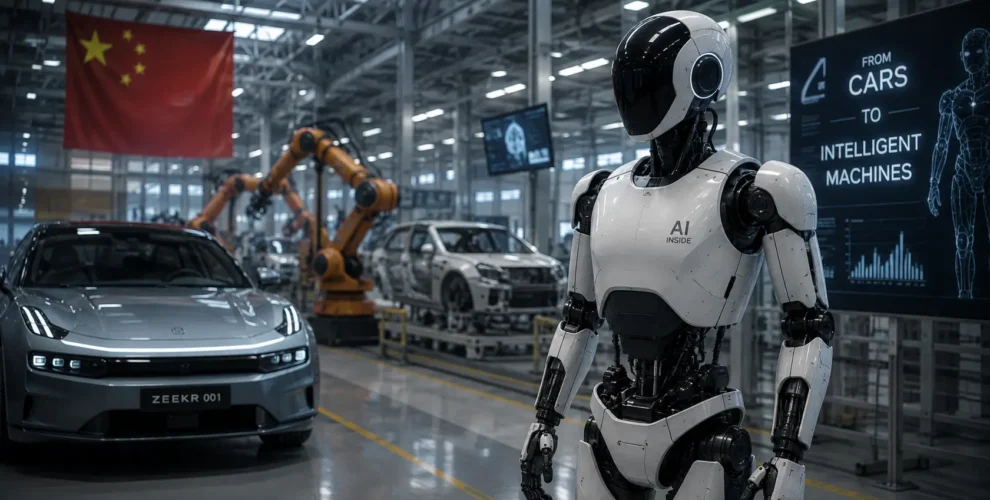
Chinese Automakers Are Betting Humanoid Robots Could Be More Profitable Than Cars
Table of Contents
Chinese Automakers Are Betting Humanoid Robots Could Be More Profitable Than Cars
China’s electric vehicle companies are looking beyond cars for their next major growth opportunity: humanoid robots.
Companies including Xpeng, BYD, Chery, Changan, GAC, Li Auto, SAIC and Seres are developing humanoid robots or investing in embodied AI, following a direction that Tesla has been promoting through its Optimus robot.
The attraction is partly financial. Competition in China’s EV market has put pressure on automakers, while robotics offers the possibility of higher margins and entirely new revenue streams.
Key Takeaways
- Several major Chinese automakers are expanding into humanoid robotics.
- Xpeng recently raised more than $900 million for its robotics business.
- The funding valued Xpeng’s robotics unit at more than $6.3 billion.
- Xpeng is developing its humanoid robot called IRON.
- BYD recently unveiled its humanoid robot, Xiao Di.
- Chery’s robotics unit AiMOGA is reportedly preparing for an IPO.
- Changan, GAC, Li Auto, SAIC and Seres are also developing humanoid robots.
- Automakers can reuse expertise from EVs, including batteries, sensors, AI and manufacturing.
- The industry still faces major challenges before humanoid robots become widely useful.
Why Are Chinese Automakers Moving Into Robots?
China’s EV industry has become intensely competitive.
Automakers are fighting over pricing, technology and market share, making it increasingly difficult to maintain strong profits from vehicle sales alone.
Robotics offers another opportunity.
Michael Dunne, CEO of advisory firm Dunne Insights, told TechCrunch that Xpeng sees increasingly thin profits in cars while viewing robots as a potentially more attractive business.
Humanoid robots could eventually be sold to factories, stores, warehouses and other businesses, creating revenue outside traditional vehicle sales.
Why Does Xpeng Stand Out?
Xpeng is making one of the biggest moves into robotics among Chinese automakers.
Its robotics division recently raised more than $900 million at a post-money valuation above $6.3 billion. Xpeng described it as the largest single private funding round in China’s embodied AI industry.
The funding round was led by IDG Capital, with participation from Gaorong Ventures and support from Tencent and Alibaba.
Xpeng plans to use the money to accelerate development and commercialization of its humanoid robot, IRON.
The company says IRON is expected to begin large-scale deliveries to retail and service-sector customers in China and overseas in 2027.
Which Other Chinese Automakers Are Building Humanoid Robots?
Xpeng isn’t alone.
BYD recently unveiled Xiao Di, its humanoid robot, while Chery has been developing robots through its AiMOGA subsidiary. AiMOGA is also reportedly preparing for a potential public listing.
Changan, GAC, Li Auto, SAIC and Seres are among the other Chinese automakers developing humanoid robotics technology.
Recent industry reporting indicates that at least 10 major Chinese automakers are now directly developing robots or operating dedicated robotics businesses.
The trend suggests robotics is becoming more than a side experiment for China’s automotive industry.
Why Are Car Companies Well Positioned to Build Robots?
Electric vehicles and humanoid robots share more technology than they might initially appear to.
Both require components and expertise involving:
batteries, electric motors, sensors, cameras, AI systems, computing hardware and advanced manufacturing.
Automakers also already operate large factories and established supply chains.
China has an additional advantage because much of the manufacturing ecosystem required for robotics already exists within its EV and electronics industries. This allows companies to build prototypes, test them and improve designs relatively quickly.
The AI systems developed for autonomous driving can also contribute to robotics research because both technologies require machines to understand and react to the physical world.
Is China Following Tesla’s Robotics Strategy?
There are clear similarities.
Tesla introduced its Optimus humanoid project in 2021, and Elon Musk has increasingly positioned Tesla as an AI and robotics company rather than simply an automaker.
Musk now spends a significant portion of Tesla earnings calls discussing AI, autonomous driving, robotaxis and robotics.
Chinese automakers are increasingly pursuing the same broader idea: technology developed for intelligent vehicles can potentially be expanded into intelligent machines.
Xpeng is particularly close to this strategy because it has invested heavily in autonomous driving as well as humanoid robots.
Are Humanoid Robots Ready for Mass Adoption?
Not yet.
Despite impressive demonstrations, humanoid robots still struggle with reliability, intelligence and adapting to unpredictable real-world environments.
China’s robotics industry has made rapid progress in hardware, but software remains a major challenge.
Robots can perform carefully trained demonstrations, but consistently completing complex factory or service tasks is much harder.
Cost is another issue.
For humanoid robots to become a large commercial market, companies will need to prove that robots can perform useful work reliably enough to justify their price.
That means the next stage of competition will be less about impressive demonstrations and more about real-world deployment.
Conclusion
Chinese automakers are beginning to see humanoid robots as more than experimental technology.
Xpeng’s $900 million robotics funding round, BYD’s Xiao Di and Chery’s growing AiMOGA business show that some of China’s biggest automotive companies are preparing for a future beyond cars.
Their EV experience gives them useful advantages in batteries, sensors, AI, supply chains and mass manufacturing.
But the biggest question remains unanswered: Can humanoid robots become reliable and useful enough to generate the profits automakers expect?
If they can, China’s next major automotive competition may not be about who sells the most electric cars — but who builds the most capable robots.
FAQs
1. Why are Chinese automakers investing in humanoid robots?
Chinese automakers see robotics as a potential new source of growth as competition and pricing pressure make the EV market increasingly difficult.
2. How much did Xpeng raise for its robotics business?
Xpeng’s robotics unit raised more than $900 million at a valuation exceeding $6.3 billion. What is Xpeng IRON?
IRON is Xpeng’s humanoid robot designed for commercial applications. The company plans large-scale deliveries to external customers beginning in 2027.
3. Is BYD developing a humanoid robot?
Yes. BYD has unveiled a humanoid robot called Xiao Di as part of its expansion into embodied AI and robotics.
4. Why do EV companies have an advantage in robotics?
EVs and humanoid robots use several overlapping technologies, including batteries, electric motors, sensors, cameras, AI systems and advanced manufacturing.
5. Are humanoid robots ready to replace human workers?
Not broadly. Current humanoid robots still face significant challenges involving intelligence, reliability, cost and performance in unpredictable environments.