
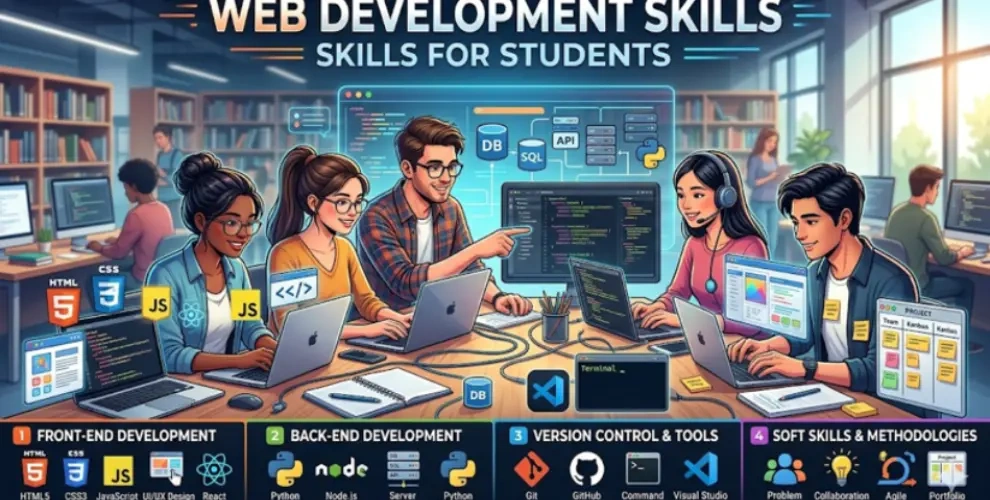
Web Development Skills for Students
Table of Contents
Introduction
Technology has become a major part of education, business, and everyday life. Almost every organization today relies on websites and online platforms to connect with customers, provide information, and offer services. As a result, web development has emerged as one of the most valuable skills students can learn.
Web development is the process of creating and maintaining websites and web applications. It combines creativity, problem-solving, and technical knowledge to build digital experiences that people use daily. Whether students want to become software developers, entrepreneurs, freelancers, or digital professionals, learning web development can open many career opportunities.
In today’s competitive job market, having web development skills provides students with an advantage. These skills help them understand how websites function, improve logical thinking, and create projects that strengthen their portfolios. Even students from non-technical backgrounds can benefit from learning the fundamentals of web development.
This article explores the most important web development skills students should learn and how these skills can support future career growth.
Understanding the Basics of Web Development
Before diving into advanced concepts, students should understand the foundation of web development. Every website is built using a combination of technologies that work together to create a functional and attractive online experience.
Web development is generally divided into three areas:
Front-End Development
Front-end development focuses on the visual part of a website that users interact with directly. It includes layouts, colors, buttons, menus, images, and overall design.
Back-End Development
Back-end development manages the server-side functionality of a website. It handles databases, user authentication, and data processing behind the scenes.
Full-Stack Development
Full-stack developers work with both front-end and back-end technologies, allowing them to build complete web applications.
Understanding these areas helps students decide which path interests them the most.
HTML: The Foundation of Every Website
HTML (Hyper Text Markup Language) is the first skill every aspiring web developer should learn. It serves as the structure of a webpage and defines elements such as headings, paragraphs, images, forms, and links.
Key benefits of learning HTML include:
- Easy to understand for beginners
- Forms the foundation of web development
- Helps students create basic web pages quickly
- Essential for understanding other web technologies
Students should practice building simple webpages using proper semantic HTML elements to develop strong fundamentals.
CSS: Creating Attractive Designs
CSS (Cascading Style Sheets) is responsible for the appearance of a website. It controls colors, fonts, spacing, layouts, and responsive design.
Without CSS, websites would appear plain and difficult to use. Learning CSS allows students to create visually appealing websites that provide a better user experience.
Important CSS concepts include:
Selectors and Properties
Students should learn how to target HTML elements and apply styles effectively.
Flexbox and Grid
These modern layout systems make it easier to create responsive and professional website designs.
Responsive Design
Responsive websites automatically adapt to different screen sizes, including smartphones, tablets, and desktops.
Responsive design has become a critical skill because most internet users access websites through mobile devices.
JavaScript: Adding Interactivity
JavaScript is one of the most important programming languages in web development. It enables websites to respond to user actions and create dynamic experiences.
Examples of JavaScript functionality include:
- Interactive forms
- Image sliders
- Real-time updates
- Pop-up notifications
- Online calculators
- Dynamic content loading
Learning JavaScript helps students develop programming logic and problem-solving abilities that are useful across many technical fields.
Version Control with Git and GitHub
Professional developers rarely work alone. They collaborate with teams and manage code changes using version control systems.
Git is a tool that tracks changes in code, while GitHub provides an online platform for storing and sharing projects.
Benefits of learning Git and GitHub include:
- Better project management
- Easy collaboration with others
- Backup of coding projects
- Exposure to industry-standard workflows
Students who maintain GitHub portfolios often make a stronger impression on recruiters and employers.
Understanding Responsive Web Design
Modern websites must function smoothly on multiple devices. Responsive web design ensures that users enjoy a consistent experience regardless of screen size.
Students should learn:
- Media queries
- Mobile-first design principles
- Flexible layouts
- Responsive images
Companies increasingly prioritize mobile-friendly websites, making responsive design an essential skill.
Learning Basic UI and UX Principles
UI (User Interface) and UX (User Experience) play a significant role in web development success.
A website should not only look attractive but also be easy to navigate and use.
Important UI and UX principles include:
Simplicity
Users should find information quickly without unnecessary distractions.
Consistency
Design elements should remain uniform across the website.
Accessibility
Websites should be usable by people with different abilities and devices.
User-Centered Design
Developers should focus on solving user problems rather than simply adding features.
Understanding these concepts helps students build websites that users genuinely enjoy.
Introduction to Back-End Technologies
While front-end skills are often the starting point, students can expand their capabilities by learning back-end development.
Popular back-end technologies include:
- PHP
- Python
- Node.js
- Java
- ASP.NET
Back-end development involves:
- Managing databases
- Handling user data
- Authentication systems
- Processing requests
Learning even basic back-end concepts provides students with a broader understanding of how web applications function.
Database Fundamentals
Most modern websites store information in databases. Examples include:
- User accounts
- Product details
- Blog posts
- Customer information
Students should understand basic database concepts such as:
Tables
Data is organized into rows and columns.
Queries
Queries retrieve and manipulate information.
Relationships
Different tables can be connected through relationships.
Common databases include MySQL, PostgreSQL, and MongoDB.
Problem-Solving and Logical Thinking
Technical skills alone are not enough. Successful developers possess strong analytical and problem-solving abilities.
Students can improve these skills by:
- Solving coding challenges
- Building personal projects
- Debugging errors independently
- Practicing algorithmic thinking
Employers highly value candidates who can identify problems and develop practical solutions.
Communication and Teamwork Skills
Web development projects often involve designers, developers, marketers, and clients working together.
Strong communication skills help students:
- Explain technical concepts clearly
- Collaborate effectively
- Understand project requirements
- Deliver better results
Soft skills are increasingly important in professional environments and can significantly influence career growth.
Importance of Continuous Learning
Technology evolves rapidly. New frameworks, programming languages, and tools appear regularly.
Students should develop a habit of continuous learning by:
- Following industry blogs
- Watching tutorials
- Participating in online communities
- Building experimental projects
A learning mindset ensures long-term success in the technology industry.
Career Opportunities in Web Development
Students who develop web development skills can pursue numerous career paths, including:
Front-End Developer
Creates user-facing website interfaces and experiences.
Back-End Developer
Manages servers, databases, and application logic.
Full-Stack Developer
Handles both front-end and back-end development tasks.
Web Designer
Focuses on visual design and user experience.
Freelance Developer
Works independently on client projects.
Entrepreneur
Builds websites, online businesses, or software products.
The demand for web development professionals continues to grow across industries.
Building a Strong Portfolio
A portfolio is one of the most effective ways for students to demonstrate their skills.
Portfolio projects may include:
- Personal websites
- Business websites
- E-commerce prototypes
- Portfolio platforms
- Blog websites
Employers often evaluate practical work more closely than academic qualifications.
Students should focus on creating projects that showcase both creativity and technical expertise.
Combining Web Development with Digital Skills
Web development becomes even more powerful when combined with digital skills such as content creation, SEO, analytics, and online marketing.
Many students enroll in a Digital Marketing Course in Udaipur to understand how websites attract visitors and generate business results. This combination creates a strong foundation for modern digital careers.
Educational institutions such as Swastik Computer Education help learners explore practical technology skills that support career development in various industries.
Future Trends in Web Development
The future of web development is exciting and filled with innovation. Emerging trends include:
- Artificial Intelligence integration
- Progressive Web Applications (PWAs)
- Voice search optimization
- Advanced cybersecurity practices
- No-code and low-code development platforms
Students who stay updated with these trends can remain competitive in the evolving digital landscape.
Conclusion
Web development is one of the most valuable skills students can learn in the digital age. From HTML and CSS to JavaScript, databases, responsive design, and problem-solving, each skill contributes to building a strong technical foundation.
These abilities not only improve employability but also encourage creativity, innovation, and entrepreneurial thinking.
Whether students aim to secure high-paying jobs, work as freelancers, or launch their own digital ventures, web development offers countless opportunities.
Want to keep up with our blog?
Our most valuable tips right inside your inbox, once per month.





Kathanshi Jain
Kathanshi Jain is a student and aspiring content writer with a keen interest in technology, education, and digital skills. She enjoys researching emerging trends and creating informative content that helps readers understand complex topics in a simple and engaging way.