
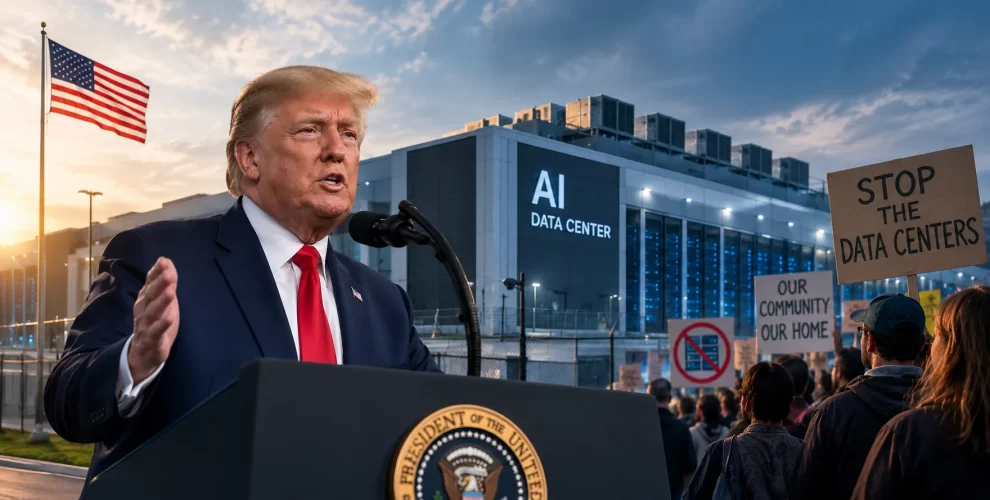
Trump Defends AI Data Centers as Local Opposition Grows Across the U.S.
Table of Contents
Trump Defends AI Data Centers as Local Opposition Grows Across the U.S.
President Donald Trump is strongly defending the expansion of AI data centers in the United States, arguing that communities should welcome the projects rather than fight them.
His comments come as opposition to large data centers is growing across the country. Residents and state leaders have raised concerns about electricity costs, grid pressure, water use, and the effect massive facilities can have on local communities.
The debate highlights a difficult question facing the U.S.: how can the country expand the infrastructure needed for artificial intelligence without shifting the costs onto nearby residents?
Key Takeaways
- Trump says opposing new AI data centers is a mistake.
- The administration views data centers as important infrastructure for U.S. AI growth.
- Opposition is growing in some communities over electricity prices and pressure on local resources.
- Texas Gov. Greg Abbott has criticized the AI industry’s handling of data center expansion.
- Trump has previously pushed large technology companies to provide their own power for data centers.
- U.S. grid operators are considering new rules for handling rapidly growing data center electricity demand.
- The broader challenge is expanding AI infrastructure without making consumers carry the additional energy costs.
Why Is Trump Defending AI Data Centers?
Trump sees data centers as an important part of America’s ability to compete in artificial intelligence.
Modern AI systems require enormous computing infrastructure. The servers running and training these models are housed inside large data centers that require substantial amounts of electricity and cooling.
As AI investment increases, companies need more of these facilities.
Trump argued that communities willing to accept them could benefit economically, while describing opposition to the projects as a mistake.
His position reflects the administration’s broader push to keep the United States competitive in the global AI race.
Why Are Some Communities Opposing Data Centers?
The problem is not necessarily the technology itself.
For many communities, the concern is what comes with the infrastructure.
Large AI data centers can require extraordinary amounts of electricity. The biggest U.S. facilities can consume more than one gigawatt of continuous power, according to Reuters—enough to supply hundreds of thousands of homes.
Rapidly adding that level of demand can require new power plants, transmission lines, substations and other grid upgrades.
Residents and businesses worry that some of those costs could eventually appear on their electricity bills.
Are AI Data Centers Raising Electricity Costs?
This has become one of the biggest arguments surrounding data center expansion.
A Reuters review found that businesses in some areas have already experienced sharply rising electricity costs as data center demand increases.
One Ohio manufacturer said its electricity costs rose 90% in a year, with a major increase in capacity charges linked largely to rising regional data center demand.
However, data centers are not the only reason U.S. electricity prices are rising.
The country’s aging grid, slow infrastructure development and existing energy policies also contribute to higher costs. Some energy experts argue that data centers are exposing problems that existed long before the current AI boom.
What Did Texas Governor Greg Abbott Say?
Interestingly, criticism isn’t coming only from Trump’s political opponents.
Texas Republican Gov. Greg Abbott recently criticized how AI companies have approached data center construction.
Abbott argued that companies failed to properly coordinate with state and local governments before rapidly expanding infrastructure and said the industry’s actions helped create the backlash it is now experiencing.
That disagreement shows that the data center debate does not fit neatly along party lines.
Local infrastructure and electricity costs can become concerns regardless of political affiliation.
Does Trump Want Tech Companies to Pay for Their Own Power?
Yes.
Trump has previously said major technology companies building AI data centers should also develop the electricity generation needed to operate them.
During his February 2026 State of the Union address, Trump said his administration had told major technology companies to build their own power plants for data centers so ordinary consumers would not have to carry the additional electricity costs.
The administration has also promoted a Ratepayer Protection Pledge aimed at preventing households from being forced to cover infrastructure costs created by large data centers.
This creates an important distinction in Trump’s position.
He supports aggressive data center construction, but argues that technology companies should shoulder more of the energy costs themselves.
How Much Power Does AI Infrastructure Need?
Potential projects show just how large AI infrastructure is becoming.
Nvidia recently committed up to $105 billion in guarantees connected to OpenAI’s planned Ohio data center project.
That site is expected to eventually reach 8 gigawatts of capacity, with its first 800 megawatts expected online in 2028.
Projects at that scale are closer to major industrial developments than traditional technology offices.
They require enormous amounts of land, electricity, cooling equipment and supporting infrastructure.
Could Data Centers Put Pressure on the U.S. Power Grid?
Yes, particularly in regions where many facilities are being constructed at once.
PJM Interconnection, the largest U.S. electricity grid operator, recently proposed a system that could require data centers to switch to backup generation when electricity supplies become dangerously tight.
That proposal illustrates how quickly AI electricity demand is changing grid planning.
Power systems traditionally designed around gradual increases in demand are now being asked to accommodate enormous facilities capable of adding hundreds of megawatts—or even gigawatts—of new demand.
Are States Trying to Restrict New Data Centers?
Some are considering it.
Earlier this year, lawmakers across roughly a dozen U.S. states were considering measures that could limit, delay or place additional conditions on large data center projects.
Concerns included electricity prices, grid reliability, water consumption and environmental effects.
Not every proposal has succeeded.
But the number of states considering restrictions shows how data centers are becoming a political issue rather than simply an infrastructure decision.
Why Are Data Centers So Important to the AI Race?
AI exists in software, but running it depends on physical infrastructure.
Companies need specialized chips, networking equipment, memory, cooling systems and enormous amounts of electricity to train and operate advanced models.
Without enough data center capacity, AI companies cannot easily expand their services.
That makes data centers strategically important as the United States competes with China and other countries in artificial intelligence.
The U.S. government is increasingly treating AI infrastructure as part of that broader technological competition.
What Is the Real Debate Around AI Data Centers?
The argument is becoming less about whether America needs AI infrastructure.
The harder question is who pays for it and where it gets built.
Technology companies want access to enormous amounts of electricity.
Governments want investment, jobs and leadership in AI.
Utilities need money to expand the grid.
Meanwhile, residents want reliable electricity without sharply higher bills, and communities want greater control over major developments in their areas.
Finding a way to satisfy all four groups could become one of the biggest infrastructure challenges created by the AI boom.
Conclusion
Trump’s defense of AI data centers shows how important the infrastructure has become to America’s technology strategy.
But growing opposition demonstrates that building the physical foundation for AI is becoming increasingly complicated.
Electricity demand, grid capacity, environmental concerns and local costs are turning data centers into a political issue across the country.
The debate is therefore no longer simply about whether the U.S. should build more AI infrastructure.
It is about how to build it without making surrounding communities pay the price.
FAQs
1. Why is Trump supporting AI data centers?
Trump views data centers as critical infrastructure for expanding artificial intelligence and maintaining U.S. competitiveness in AI.
2. Why are people opposing AI data centers?
Common concerns include rising electricity costs, pressure on local power grids, water consumption, environmental effects and the scale of new infrastructure required.
3. Do AI data centers use a lot of electricity?
Yes. The largest U.S. data centers can consume more than a gigawatt of continuous electricity, comparable to the power needs of hundreds of thousands of homes.
4. Does Trump want tech companies to pay for data center electricity?
Trump has said large technology companies should build or provide the power generation needed for their data centers rather than shifting additional costs onto ordinary electricity customers.
5. Are U.S. states restricting data centers?
Several states have considered legislation that would restrict or add conditions to major data center developments because of concerns about electricity, water and local infrastructure.
6. Why are AI data centers important?
They contain the computing hardware needed to train and operate AI models. As AI usage grows, companies require more computing capacity and therefore more data center infrastructure.
7. Could AI data centers affect household electricity bills?
They can contribute to higher regional power demand and infrastructure costs, although data centers are not the only factor affecting electricity prices. How utilities and regulators allocate those costs is particularly important.