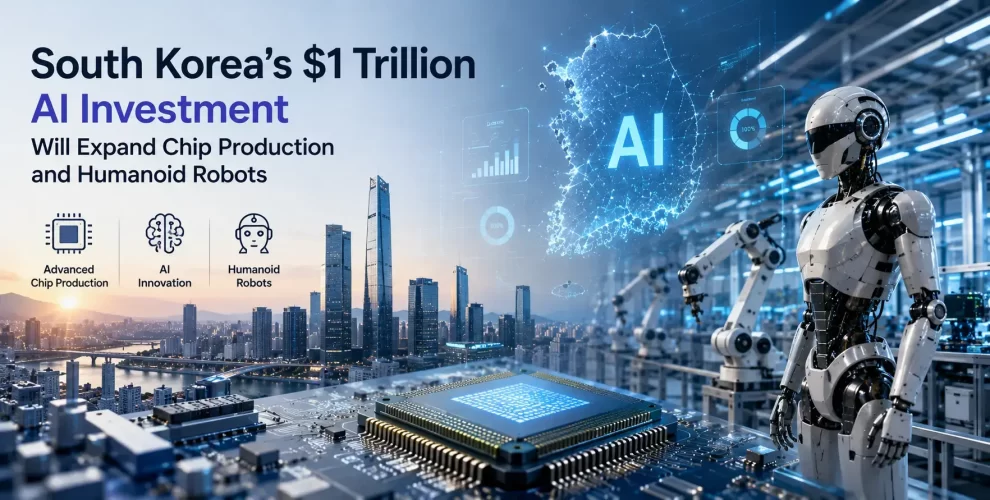
South Korea’s $1 Trillion AI Investment Will Expand Chip Production and Humanoid Robots
South Korea is making one of its biggest technology investments ever with a $1 trillion AI investment focused on memory chips, AI infrastructure, and humanoid robots.
The plan aims to strengthen the country’s position in the global AI industry while supporting future demand for advanced technologies.
A Massive Boost for Memory Chip Production
A large portion of the investment will go toward building new semiconductor manufacturing facilities and expanding existing production capacity.
South Korea wants to significantly increase the output of memory chips, which are essential for AI servers, smartphones, computers, and data centers.
As demand for AI continues to grow worldwide, memory chips have become one of the most important components in modern technology.
Increasing production could help improve supply over the coming years, although new factories will take time to become fully operational.
More AI Data Centers Across the Country
The investment also includes the construction of new AI data centers in different regions of South Korea.
These facilities will provide the computing power needed to train and operate advanced AI models.
Expanding data center infrastructure is expected to support businesses, cloud services, and future AI applications while helping the country keep pace with growing global demand for AI computing.
Humanoid Robots Are Part of the Plan
Another major goal of the South Korea $1 Trillion AI Investment is to speed up the development and commercial use of humanoid robots.
The government plans to encourage robots in industries such as manufacturing, logistics, and other workplaces where repetitive tasks can be automated.
Companies are expected to increase robot production over the next few years while also investing in AI systems that allow robots to work more efficiently in real-world environments.
Opportunities and Challenges
While the investment could strengthen South Korea’s technology leadership, it also brings new challenges.
Large semiconductor plants and AI data centers require huge amounts of electricity and water, making infrastructure expansion an important part of the project.
The growing use of humanoid robots has also raised concerns about future jobs.
As automation increases, governments and businesses may need to invest more in workforce training so employees can adapt to changing technologies.
Conclusion
The South Korea $1 Trillion AI Investment highlights the country’s long-term commitment to artificial intelligence and advanced manufacturing.
By expanding chip production, building new AI data centers, and supporting humanoid robots, South Korea is preparing for the next generation of AI innovation while strengthening its role in the global technology industry.