
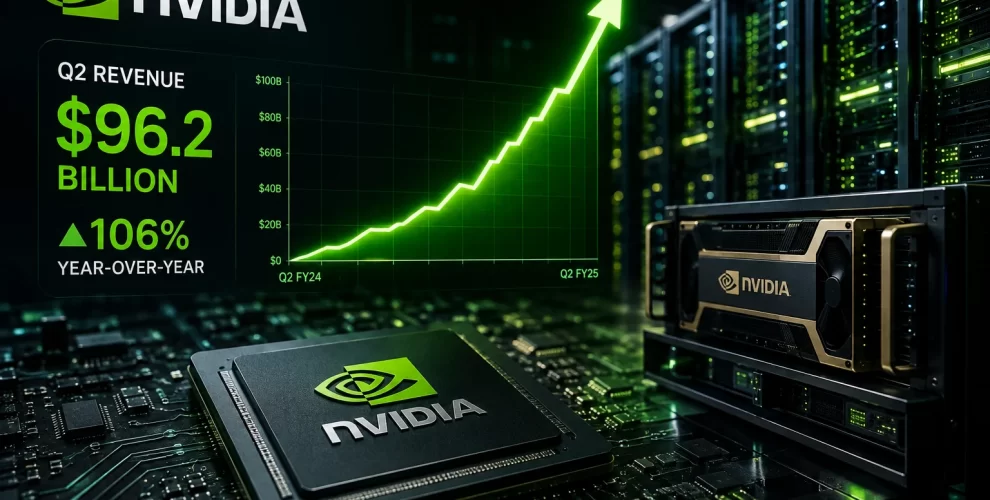
Nvidia’s Q2 Revenue Soars 106% to $96.2 Billion as AI Demand Accelerates
Table of Contents
Nvidia’s Q2 Revenue Soars 106% to $96.2 Billion as AI Demand Accelerates
Nvidia has delivered another blockbuster quarter, showing that global spending on artificial intelligence infrastructure is still expanding at a remarkable pace.
For the second quarter of fiscal 2027, Nvidia reported $96.2 billion in revenue, up 106% from a year earlier and 18% from the previous quarter. Net income climbed even faster, rising 126% year over year to $59.7 billion.
The biggest driver remains Nvidia’s Data Center business, which generated $89 billion during the quarter as demand for AI computing infrastructure continued to grow.
Key Takeaways
- Nvidia generated $96.2 billion in Q2 FY2027 revenue.
- Revenue increased 106% year over year and 18% quarter over quarter.
- Net income reached $59.7 billion, up 126% from a year earlier.
- Data Center revenue surged to $89 billion, growing 117% year over year.
- Edge Computing revenue reached $7.2 billion.
- Nvidia’s Vera Rubin platform has entered full production.
- Nvidia expects approximately $108 billion in Q3 revenue.
- The Q3 forecast does not include Data Center compute revenue from China.
- Nvidia is working with financial partners on platforms that could mobilize more than $500 billion for AI infrastructure.
How Much Revenue Did Nvidia Generate in Q2?
Nvidia reported $96.22 billion in revenue for the quarter ended July 26, 2026.
A year earlier, the company generated $46.74 billion. That means quarterly revenue has more than doubled in just 12 months.
Revenue also increased 18% compared with the previous quarter’s $81.62 billion.
The results exceeded Wall Street expectations of roughly $92.2 billion, providing another indication of the strength of spending on AI infrastructure.
How Much Profit Did Nvidia Make?
Nvidia’s growth wasn’t limited to sales.
GAAP net income increased to $59.69 billion, compared with $26.42 billion during the same period last year—a rise of 126%.
Diluted earnings per share increased from $1.08 to $2.46, representing 128% year-over-year growth.
Operating income also climbed 124% to approximately $63.7 billion.
Meanwhile, Nvidia’s gross margin reached 75%, compared with 72.4% a year earlier.
Why Is Nvidia Growing So Quickly?
The simple answer is AI infrastructure.
Companies worldwide are spending enormous amounts of money building the computing capacity required to train and operate increasingly sophisticated AI models.
Nvidia supplies much of the hardware and software behind those systems.
Demand is also broadening. AI infrastructure is no longer being built only by a handful of major technology companies. Frontier AI labs, startups, enterprises, governments and industrial companies are all increasing their investment in AI computing.
That expansion is helping Nvidia sustain extraordinary growth even after several years of rapidly rising AI demand.
How Important Is Nvidia’s Data Center Business?
Data Center is overwhelmingly Nvidia’s largest growth engine.
The division generated $89 billion in Q2 revenue, representing an increase of 117% from the same period last year and 18% from the previous quarter.
To put that into perspective, Data Center alone accounted for more than 90% of Nvidia’s total quarterly revenue.
This reflects how dramatically Nvidia’s business has changed.
The company was once best known by consumers for GeForce gaming graphics cards. Today, its financial performance is dominated by the infrastructure used to build and operate artificial intelligence systems.
What Is Happening With Nvidia’s Vera Rubin Platform?
Another important part of Nvidia’s growth story is Vera Rubin, its next-generation AI computing platform.
Nvidia says Vera Rubin is now ramping into full production, with systems operating at partners including CoreWeave, Google Cloud, Microsoft Azure, Oracle Cloud Infrastructure and Nebius.
The platform is designed for increasingly demanding AI workloads as companies move toward larger models, AI agents and other compute-intensive applications.
Nvidia is betting that demand will continue expanding as these workloads become more widely deployed.
What Is Nvidia Doing Beyond Data Centers?
AI servers may dominate Nvidia’s financial results, but the company is expanding aggressively into other areas.
Its Edge Computing business generated $7.2 billion, growing 27% year over year.
Nvidia also announced or expanded initiatives involving Windows AI PCs, autonomous vehicles, humanoid robots and physical AI.
The company introduced technologies including its Cosmos 3 model for physical AI, the Isaac GR00T humanoid robot reference design and Nvidia Halos, a safety platform for robotics.
These initiatives show Nvidia’s ambition to move beyond supplying chips for cloud-based generative AI.
It increasingly wants its computing platform to power AI systems operating in the physical world.
Why Is Nvidia Investing in AI Infrastructure Financing?
Building AI data centers is extremely expensive.
The industry needs chips, networking equipment, land, cooling infrastructure and enormous amounts of electricity.
Nvidia says it has formed strategic partnerships with major financial groups including Apollo, BlackRock, Blackstone, Brookfield, Goldman Sachs and KKR to establish independent compute-financing platforms.
Those arrangements could eventually mobilize more than $500 billion in third-party capital for AI infrastructure, subject to final agreements.
The strategy highlights how AI’s expansion is increasingly becoming an infrastructure-financing challenge, not simply a semiconductor problem.
What Does Jensen Huang Say About AI Demand?
Nvidia CEO Jensen Huang believes the AI market has reached an important stage where artificial intelligence is producing measurable economic value.
He argues that demand is broadening as more AI labs, startups, enterprises and physical-AI projects scale simultaneously.
That is important for Nvidia.
If AI spending depended heavily on only a small number of technology giants, the company’s growth could become vulnerable if those companies reduced capital expenditure.
A broader customer base could make demand more durable.
What Does Nvidia Expect for Q3?
Nvidia isn’t expecting growth to slow dramatically in the current quarter.
The company forecasts approximately $108 billion in Q3 FY2027 revenue, plus or minus 2%.
Nvidia expects gross margins of approximately 74%.
Importantly, the forecast assumes no Data Center compute revenue from China, reflecting the continuing uncertainty surrounding U.S. export restrictions and Nvidia’s access to the Chinese AI chip market.
Could Nvidia’s Growth Continue?
Nvidia believes the AI infrastructure boom still has significant room to expand.
Reuters reports that the company expects revenue to grow around 70% in fiscal 2028, substantially above the roughly 44% growth analysts had expected.
Demand is also reportedly running ahead of available supply in some areas.
However, Nvidia still faces important risks.
AI infrastructure spending needs to generate sufficient returns for the companies investing hundreds of billions of dollars in it. Nvidia also faces growing competition from AMD and custom AI chips developed by major cloud companies.
Supply constraints, memory costs and geopolitical restrictions remain additional challenges.
Why Nvidia’s Q2 Results Matter
Nvidia’s latest earnings provide one of the clearest indicators of how much money continues to flow into AI infrastructure.
A 106% annual revenue increase would be extraordinary for almost any company. Achieving that growth at Nvidia’s enormous scale is particularly significant.
Even more revealing is where that money is coming from.
Of Nvidia’s $96.2 billion in quarterly revenue, $89 billion came from Data Center.
That suggests the global race to build AI computing capacity remains one of the technology industry’s largest investment cycles.
Conclusion
Nvidia’s second-quarter results show that the AI infrastructure boom is still accelerating.
Revenue more than doubled to $96.2 billion, while Data Center sales jumped 117% to $89 billion and net income reached nearly $60 billion.
Meanwhile, Vera Rubin is entering production, Nvidia is expanding into robotics and physical AI, and the company expects quarterly revenue to cross $100 billion in Q3.
The bigger story isn’t simply that Nvidia sold more chips.
It’s that AI computing is rapidly becoming a massive global infrastructure industry—and Nvidia remains at the center of it.
FAQs
1. How much revenue did Nvidia make in Q2 FY2027?
Nvidia generated $96.2 billion in revenue, an increase of 106% from the same quarter a year earlier.
2. How much profit did Nvidia make?
Nvidia reported GAAP net income of approximately $59.7 billion, up 126% year over year.
3. How much did Nvidia’s Data Center business generate?
Data Center revenue reached $89 billion, increasing 117% compared with the previous year.
4. Why is Nvidia’s revenue growing so quickly?
The main driver is global demand for AI computing infrastructure. Cloud providers, AI companies, enterprises and other organizations continue investing heavily in Nvidia-powered systems.
5. What is Nvidia Vera Rubin?
Vera Rubin is Nvidia’s next-generation AI computing platform. Nvidia says it is now ramping into full production, with systems running at several major cloud and infrastructure partners.
6. How much revenue does Nvidia expect next quarter?
Nvidia expects approximately $108 billion in Q3 FY2027 revenue, plus or minus 2%.
7. Does Nvidia’s Q3 forecast include China revenue?
Nvidia says its Q3 outlook assumes no Data Center compute revenue from China.
8. Is Nvidia still growing beyond AI data centers?
Yes. Nvidia is expanding across edge computing, AI PCs, autonomous vehicles, robotics and physical AI, although Data Center remains by far its largest revenue source.