I Tried Meta’s Pocket App: Vibe Coding Makes Game Creation Surprisingly Easy
Table of Contents
I Tried Meta’s Pocket App: Vibe Coding Makes Game Creation Surprisingly Easy
Meta is taking vibe coding beyond traditional software development with Pocket, an AI-powered app that lets people create small interactive games using simple text prompts.
Instead of writing code or learning a game engine, users describe what they want to build. Pocket generates a playable experience that can then be tested, modified, shared, or remixed by others.
Following an initial test in Brazil, Meta began rolling Pocket out broadly to users in the U.S. in August 2026.
Key Takeaways
- Meta Pocket lets users create mini-games without writing code.
- Users build games by describing their ideas in natural language.
- Pocket calls its interactive creations “gizmos.”
- Gizmos can respond to taps, dragging, phone movement, sound, camera input, and photos.
- Users can play, share, save, repost, and remix content created by others.
- Pocket includes a vertical social feed built around interactive content.
- The app is powered by Meta’s Muse Spark model.
- Pocket is currently rolling out in the U.S. after earlier testing in Brazil.
What Is Meta Pocket?
Pocket is Meta’s experimental platform for creating and sharing small interactive experiences with AI.
Instead of opening a coding editor, users enter a prompt describing what they want.
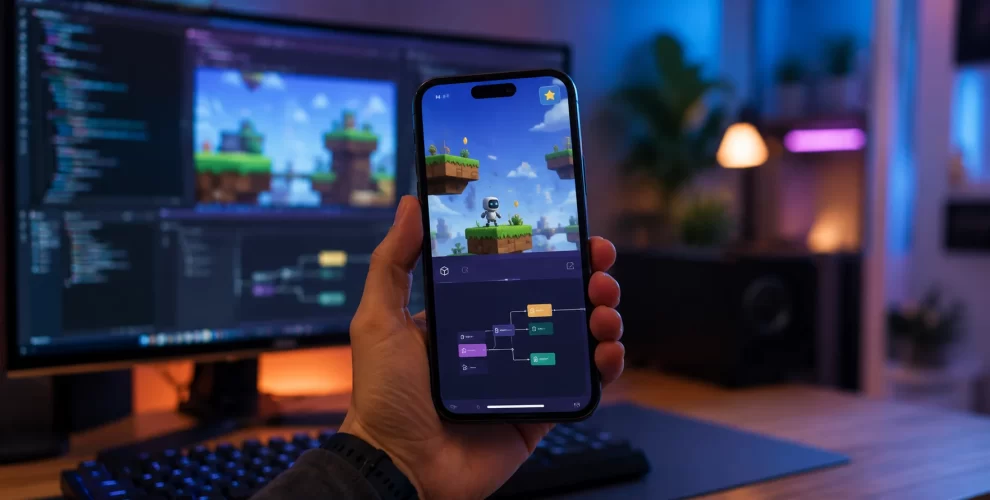
Pocket then turns that description into what Meta calls a gizmo—a small playable experience that can respond to actions on a smartphone.
The idea is to make interactive creation accessible to people who have ideas for games but don’t necessarily know how to program them.
How Does Vibe Coding Work in Pocket?
The process is intentionally simple.
You describe the experience you want to create using everyday language. Pocket’s AI interprets the request and builds an interactive result.
If the first version isn’t right, you can continue adjusting the prompt and refining the creation. Users can also modify visuals and add music.
This is the basic idea behind vibe coding: tell AI what you want instead of manually writing the code required to build it.
What Kind of Games Can Pocket Create?
Pocket is mainly designed for lightweight, casual experiences rather than large traditional video games.
Its gizmos can respond to different smartphone inputs, including:
- Touch and dragging
- Phone tilting
- Sound effects
- Music
- Camera access
- Photos from the camera roll
That opens the door to simple games, quizzes, puzzles, interactive memes, visual experiments, and other small experiences.
Pocket is therefore less like a replacement for professional game engines and more like a fast creative playground.
Do You Need Coding Skills to Use Pocket?
No.
That’s one of Pocket’s main selling points.
Users don’t need to understand programming languages or traditional game-development tools. They can describe the mechanics or idea they want, and AI handles much of the technical work behind it.
This makes Pocket particularly interesting for people who have creative ideas but have never built software before.
Is Pocket Also a Social Media App?
Yes, and this is where Meta’s approach becomes more interesting.
Pocket isn’t just a game-generation tool. It also has a vertical social feed where users can discover interactive creations made by other people.
Users can interact with gizmos, like them, comment, repost, save them, or remix existing creations into something new.
Instead of scrolling through photos or short videos, you’re effectively scrolling through small interactive experiences.
That gives Pocket elements of both a creation platform and a social network.
What Does “Remixing” Mean in Pocket?
If you find a gizmo you like, you don’t necessarily have to start from zero.
Pocket allows users to remix existing creations.
You can take someone else’s idea and change parts of it to produce your own version.
That could make experimentation much easier because users can learn from existing creations rather than having to understand how every interaction was originally produced.
It’s similar to the remix culture already common with memes and short-form videos, except the content itself is interactive.
Where Did Pocket Come From?
Pocket has strong ties to Gizmo, an earlier platform developed by Atma Sciences.
Meta hired the team behind Gizmo and licensed its technology earlier in 2026. Pocket builds on that work, and the original Gizmo app is being shut down as Meta rolls out its own version.
This explains why Pocket’s interactive creations are still called “gizmos.”
What AI Model Powers Meta Pocket?
Pocket runs on Muse Spark, an AI model developed by Meta Superintelligence Labs.
The model helps translate users’ ideas into interactive experiences.
For users, however, the technical model is mostly hidden behind the interface.
The experience is designed around creating rather than programming.
Why Could Pocket Be Important?
Pocket represents a different direction for generative AI.
Most consumer AI tools began with text, then expanded into images, audio, and video.
Pocket pushes AI toward interactive content.
Instead of asking AI to generate something you simply read or watch, you’re asking it to create something you can actually interact with.
That could make prompt-based creation accessible to a much larger group of people.
Someone who would never learn traditional game development could potentially create a simple interactive idea within minutes.
Is Pocket a Replacement for Professional Game Development?
No.
Professional games involve far more than generating a basic playable concept. Developers need control over performance, graphics, physics, security, multiplayer systems, monetization, testing, and many other areas.
Pocket focuses on smaller interactive experiences.
Its strength is speed and accessibility, not replacing professional development platforms.
For creators, it may be more useful as a place to experiment with ideas quickly than as a tool for building a large commercial game.
Could Vibe Coding Change Who Creates Games?
Potentially.
Traditional game development has a high entry barrier because users need programming, design, or specialized software skills.
AI lowers that barrier.
If someone can move from:
Idea → Prompt → Playable Experience
without learning to code first, many more people can experiment with interactive creation.
That doesn’t eliminate the value of developers. It changes who can create a basic prototype and how quickly they can do it.
Why Is Meta Building a Social Network Around AI Games?
Pocket fits into Meta’s broader push to make AI-generated content part of everyday social experiences.
Rather than limiting AI creation to professional developers, Meta is experimenting with formats where ordinary users can generate content and immediately distribute it.
Pocket also joins several standalone apps Meta has been launching as it experiments with new formats and audiences. CEO Mark Zuckerberg has said AI-assisted software development is helping the company test and ship new app ideas more quickly.
For now, Meta says there are no plans to integrate Pocket directly with apps such as Instagram.
Conclusion
Meta’s Pocket shows how vibe coding is moving from developer tools into consumer entertainment.
The app removes much of the technical barrier between having an idea and turning it into something playable. Users can describe a mini-game, let AI build it, refine the result, and immediately share it with others.
Pocket is still focused on small interactive experiences rather than serious game development. But the bigger idea is worth watching.
AI-generated content is moving beyond things we read, see, and watch.
With tools like Pocket, it is increasingly becoming something we can play and interact with.
FAQs
1. What is Meta Pocket?
Meta Pocket is an AI-powered app that lets users create, play, share, and remix small interactive experiences called gizmos using natural-language prompts.
2. What is vibe coding in Meta Pocket?
Vibe coding means describing the game or interactive experience you want in normal language and letting AI generate the underlying experience instead of manually writing the code.
3. Do you need coding knowledge to use Meta Pocket?
No. Pocket is specifically designed to let people create interactive experiences without traditional programming skills.
4. What can Pocket gizmos do?
Gizmos can respond to touch, dragging, phone tilt, sounds, music, camera input, and photos from a user’s camera roll.
5. Can you play games created by other Pocket users?
Yes. Pocket includes a scrollable feed where users can discover, play, save, repost, comment on, and remix creations from other users.
6. What AI model powers Meta Pocket?
Pocket is powered by Meta’s Muse Spark model, developed by Meta Superintelligence Labs.
7. Is Meta Pocket available everywhere?
No. Pocket was initially tested in Brazil and began rolling out broadly to users in the United States in August 2026. Wider international availability has not yet been confirmed.
8. Is Pocket meant to replace professional game development?
No. Pocket is currently better suited to quick mini-games and interactive experiments than complex professional games.