
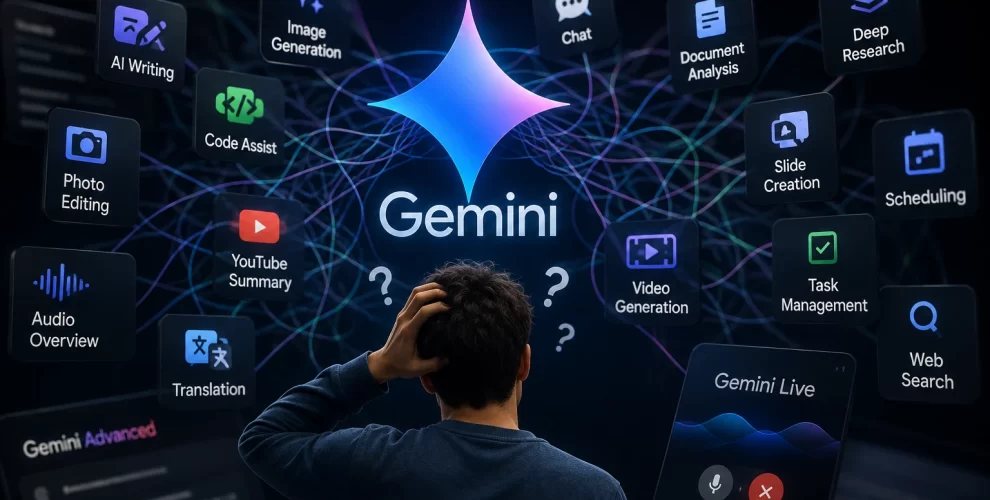
Google Gemini’s Growing List of AI Features Is Creating a Branding Problem
Table of Contents
Google Gemini’s Growing List of AI Features Is Creating a Branding Problem
Google is making Gemini more capable, but there may be a downside to adding a separate name and interface for nearly every new AI capability.
The Gemini app now includes experiences such as Chat, Spark and Daily Brief, alongside a growing family of Gemini models and tools. TechCrunch argues that this expansion is creating unnecessary complexity for everyday users who simply want AI to understand a request and complete it.
And Google isn’t alone. Across the AI industry, companies are increasingly asking consumers to understand different modes, agents, models and product names before deciding how to accomplish a task.
Key Takeaways
- Google Gemini now separates experiences such as Chat, Spark and Daily Brief.
- Spark is designed as an AI agent that can perform tasks on a user’s behalf.
- Daily Brief provides proactive personalized updates using information from Google services.
- Google says the Gemini app now serves more than 900 million monthly users across 230 countries and more than 70 languages.
- TechCrunch argues that too many separately branded features can make Gemini harder to understand.
- The problem isn’t limited to Google; other major AI assistants also divide capabilities into different modes.
- Simpler AI experiences may ultimately be more attractive to mainstream consumers.
- The broader challenge for AI companies is shifting from adding capabilities to making those capabilities feel like one coherent assistant.
What Is Google Gemini’s Branding Problem?
Gemini isn’t just the name of one AI model anymore.
Google uses Gemini across models, apps and features. Within the consumer Gemini experience itself, users can encounter different options designed for different kinds of tasks.
Google introduced Daily Brief as a proactive personalized assistant and Gemini Spark as an agent capable of managing tasks.
The individual capabilities may be useful.
The problem is that users increasingly have to understand what each name means before deciding where to start.
Instead of simply asking Gemini for something, a person may wonder whether the request belongs in regular Chat, Spark or another feature.
That’s the friction TechCrunch argues Google should eliminate.
What Is Gemini Spark?
Gemini Spark is Google’s more agentic AI experience.
Unlike a conventional chatbot that primarily responds with information, Spark is designed to take action and manage tasks on the user’s behalf. Google describes it as a personal AI agent capable of working around the clock under the user’s direction.
Google has since expanded Spark globally in supported markets and connected Gemini with additional third-party apps.
That makes Spark potentially one of Gemini’s more useful capabilities.
But TechCrunch’s criticism is that consumers shouldn’t necessarily have to know the name “Spark” to use agentic features.
Ideally, they should simply tell Gemini what they want done, and Gemini should determine whether an agent needs to handle the request.
What Is Gemini Daily Brief?
Daily Brief takes a different approach.
It provides proactive, personalized information based partly on data from connected Google services such as Gmail and Calendar.
The idea is to make Gemini useful even before someone asks it a question.
For example, an AI assistant could surface information about upcoming commitments or other relevant items at the beginning of the day.
However, proactive AI introduces another challenge: deciding what is actually important enough to interrupt the user about.
TechCrunch criticized Daily Brief for sometimes surfacing information that may not feel urgent or useful, including reminders connected with previous activity.
This highlights a broader challenge for personal AI assistants. Knowing more about a user doesn’t automatically mean every piece of that knowledge should be resurfaced.
Why Can Too Many AI Features Become Confusing?
Traditional software often requires users to select the correct tool.
AI promises something different.
In theory, users should be able to describe their goal naturally and allow the system to decide which capabilities are required.
For example, a user shouldn’t necessarily need to understand whether something requires:
a chatbot → an agent → search → email access → calendar access.
People should only have to tell the AI what they need.
The AI should handle the complexity behind the scenes.
When companies expose too much of that underlying architecture, AI starts behaving more like traditional software with complicated menus.
That’s exactly what conversational interfaces were supposed to simplify.
Gemini’s Model Names Add Another Layer
The consumer features are only part of Google’s expanding AI vocabulary.
Google’s model portfolio includes names such as Gemini 3.7 Flash, Gemini 3.6 Flash, Gemini 3.5 Flash-Lite, Gemini Omni, Gemini Audio and Gemini Robotics, among others.
These distinctions make sense for developers who need to choose models based on performance, latency, cost or capabilities.
They matter much less to ordinary consumers.
Google has already moved partly toward hiding that complexity. For example, Gemini 3.5 Flash became the default model for the Gemini app when it launched, meaning users didn’t necessarily need to manually choose it.
That could be a useful direction for the rest of the product.
Is This Problem Limited to Google?
No.
That’s one of the most important points in the discussion.
TechCrunch argues that much of the AI industry has a similar tendency to expose internal product architecture directly to consumers.
Different AI companies now offer separate experiences for chatting, deeper research, agents, coding, image generation, workspaces and other activities.
From an engineering perspective, those distinctions can make sense.
From the user’s perspective, however, the question is usually much simpler:
“Can the AI do what I asked?”
As assistants gain more capabilities, the pressure to simplify those choices will increase.
Why Could Apple’s Approach Be Different?
Apple offers an interesting contrast.
Rather than asking consumers to move their work into a completely separate AI destination, Apple’s broader approach has emphasized adding intelligence to familiar experiences.
That could mean making existing tools such as Siri, Spotlight, Photos and the camera smarter while allowing people to continue using them largely as they already do.
There is an important usability advantage to this strategy.
Consumers don’t necessarily care which AI model performs a task.
They care whether the feature they already use suddenly becomes more useful.
If AI increasingly disappears into existing interfaces, consumers may not need to think about “using AI” at all.
They will simply use better software.
Why Are Text-Based AI Assistants Becoming Interesting?
Another alternative is even simpler: messaging.
Several emerging AI services are experimenting with assistants that users interact with much like they would text another person.
The appeal is obvious.
Everyone already understands how messaging works.
There are no complicated dashboards, modes or model selectors. A user sends a request, and the assistant responds or performs the requested action.
That model could become increasingly attractive as AI agents become capable of doing more work independently.
The best interface for a powerful AI assistant may ultimately be the interface people already understand.
Does Google Actually Need All These Names?
From Google’s perspective, there are understandable reasons for naming individual products.
Distinct brands help the company market new capabilities, organize development teams and explain major launches.
Developers also need clear names for models and APIs.
But consumer software has different requirements.
A user doesn’t necessarily need to understand the infrastructure behind a task.
For example, someone saying:
“Find a good restaurant for Friday and add the reservation to my calendar.”
shouldn’t need to determine which agent, model or mode is responsible.
If Gemini has all the necessary capabilities and permissions, the ideal experience would be for Gemini to determine the workflow automatically.
Is Gemini Becoming More Capable Despite the Confusion?
Absolutely.
The branding criticism shouldn’t be confused with an argument that Gemini lacks capabilities.
Google says Gemini has grown to more than 900 million monthly users, and the company continues expanding the assistant across search, productivity, multimodal creation and agentic tasks.
Recent Gemini improvements include interactive simulations, personalized experiences, more capable Flash models, multimodal creation and integrations with additional applications.
In fact, the branding challenge may partly exist because Gemini has become capable of doing so many different things.
Google now needs to make those capabilities feel simpler than the technology underneath them.
What Could the Ideal AI Assistant Look Like?
The future AI interface may have surprisingly few buttons.
Instead of choosing between different modes, users could simply describe their desired outcome.
The assistant would then determine whether it needs to:
search the web, reason through a problem, generate content, access email, inspect a calendar, launch an agent or interact with another application.
The user wouldn’t necessarily need to know which model performed each step.
That would represent a significant shift from today’s AI products.
Rather than users learning how the AI works, the AI would learn how to interpret what users want.
Why This Matters for the AI Industry
AI companies are currently competing heavily on intelligence.
Benchmarks, reasoning scores, coding performance, context windows and model capabilities receive enormous attention.
But as the underlying technology improves, user experience could become an equally important competitive advantage.
The winning consumer AI product may not necessarily be the one with the longest list of features.
It could be the one that makes those features almost invisible.
That means the next phase of AI competition could increasingly be about removing complexity rather than adding more of it.
Conclusion
Google’s Gemini branding problem reflects a much larger challenge facing consumer AI.
Gemini has become increasingly capable, with agents, proactive assistance, multimodal models and integrations across Google’s ecosystem. But each additional branded mode or feature gives users something else they may feel they need to understand.
The same tension exists across the AI industry.
Behind the scenes, AI systems will inevitably become more complicated.
For consumers, however, the experience may need to move in exactly the opposite direction.
The best AI assistant may ultimately be the one where users don’t have to know which model, mode or agent they’re using—they simply ask, and it works.
FAQs
1. What is Google Gemini’s branding problem?
The concern is that Gemini contains a growing number of separately named features and modes, which can make users think about which tool they need instead of simply asking the AI to complete a task.
2. What is Gemini Spark?
Gemini Spark is Google’s personal AI agent designed to perform and manage tasks on a user’s behalf.
3. What is Gemini Daily Brief?
Daily Brief is a proactive Gemini feature that provides personalized updates using information from connected services such as Gmail and Calendar.
4. How many people use the Gemini app?
Google said in May 2026 that the Gemini app had more than 900 million monthly users across 230 countries and over 70 languages.
5. Is Gemini’s branding issue unique to Google?
No. Other AI companies also separate capabilities into different modes, products and interfaces. TechCrunch argues that this reflects a broader usability problem across consumer AI.
6. Why can AI model names confuse consumers?
Model distinctions are useful to developers, but ordinary users typically care more about completing their task than deciding which underlying AI model is best suited for it.
7. Could simpler AI interfaces become more popular?
Potentially. Interfaces such as messaging are already familiar to consumers and allow people to focus on what they want accomplished rather than selecting between AI tools or modes.
8. What could make Gemini easier to use?
A more unified experience could allow users to make a request while Gemini automatically chooses the appropriate model, agent, search capability or connected service behind the scenes.