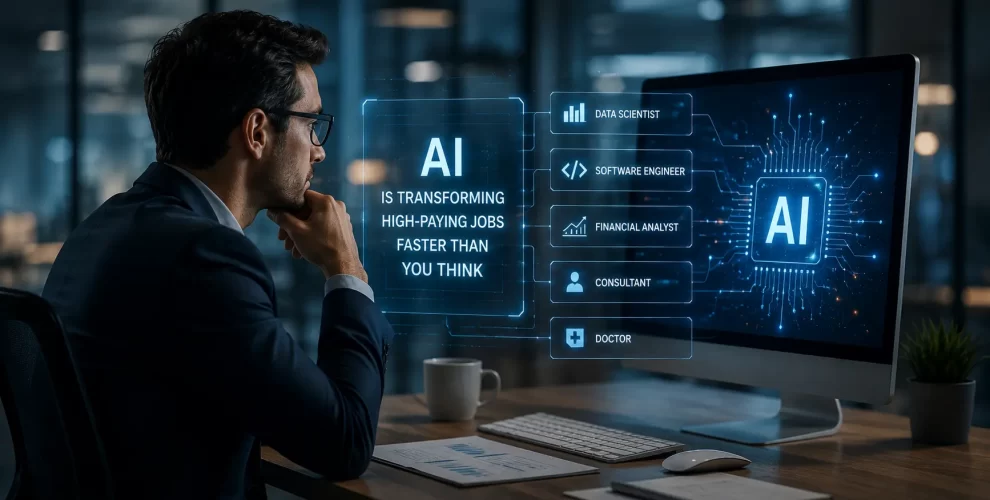
AI Is Changing High-Paying Jobs Faster Than Many People Expected
When people first started talking about artificial intelligence, most assumed it would mainly replace repetitive or manual work. But that prediction is proving incomplete.
Today, AI is beginning to influence jobs that require years of education and professional experience. From software development to finance and marketing, businesses are finding new ways to complete knowledge-based work with AI assistance.
The result isn’t a sudden disappearance of every job. Instead, companies are rethinking which tasks need people and which can now be completed with intelligent software.
Why Experienced Professionals Are Feeling the Impact
Modern AI tools can write reports, summarize research, generate computer code, analyze spreadsheets, prepare presentations, and organize large amounts of information within minutes.
These were once considered tasks that required trained professionals.
Because of this, some organizations are reducing hiring, combining roles, or restructuring teams instead of expanding their workforce.
This doesn’t mean expertise has become unimportant. It means employers are expecting professionals to contribute beyond work that AI can now perform quickly.
AI Is Transforming Jobs More Than Eliminating Them
One of the biggest misconceptions is that AI simply replaces workers.
In reality, many companies are redesigning jobs instead of removing them completely.
For example, a marketing professional may spend less time creating first drafts because AI can generate them instantly. Their focus shifts toward strategy, creativity, customer insights, and campaign decisions.
The same pattern is appearing in software development, finance, consulting, customer support, and many other industries.
Employers Are Looking for Different Skills
As AI becomes part of everyday business, technical knowledge alone is no longer enough.
Companies increasingly value employees who can:
- Make informed decisions.
- Solve complex business problems.
- Think creatively.
- Communicate effectively with teams and clients.
- Use AI tools responsibly to improve productivity.
These human abilities remain difficult for AI to replace.
Learning AI Is Becoming a Career Advantage
Ignoring AI is becoming harder as more workplaces adopt it.
Professionals who understand how AI fits into their industry can often complete work faster, improve accuracy, and handle larger projects.
Learning how to work alongside AI is quickly becoming a valuable career skill rather than an optional extra.
Should You Be Concerned?
AI will continue changing how work gets done, but that doesn’t automatically mean fewer career opportunities.
Throughout history, new technologies have replaced certain tasks while creating entirely new types of work.
The rise of AI is creating another major change in the way people work and build careers.
The professionals who adapt early are likely to benefit the most as businesses continue investing in AI-powered tools.
Conclusion
Artificial intelligence is changing expectations across many industries, including roles that once seemed difficult to automate. While some responsibilities are becoming less dependent on human effort, demand for creativity, leadership, critical thinking, and sound decision-making continues to grow. The future belongs to professionals who can combine their expertise with AI rather than compete against it.