
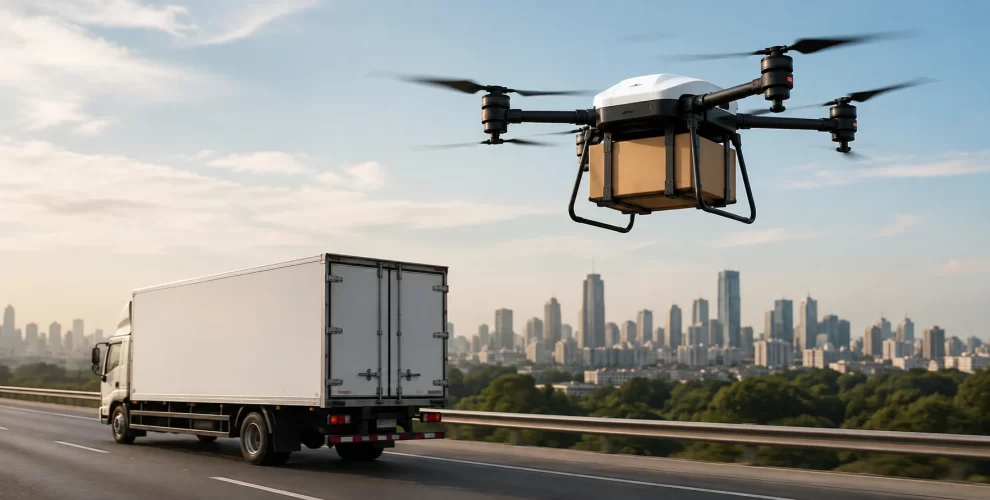
India’s Airbound Secures $37M to Make Drone Deliveries as Affordable as Truck Transport
Table of Contents
India’s Airbound Secures $37M to Make Drone Deliveries as Affordable as Truck Transport
Indian drone startup Airbound has raised $37 million in Series A funding as it works toward an ambitious goal: making aerial delivery competitive with trucks on cost.
The Bengaluru-based company is developing lightweight, autonomous rocket-like drones that take off vertically before transitioning into horizontal flight. Airbound believes this design could eventually make drones practical for healthcare, retail, and e-commerce deliveries at much larger scale.
Key Takeaways
- Airbound raised $37 million in a Series A round led by Greenoaks.
- DoorDash, Lightspeed, Lachy Groom, and Humba Ventures also participated.
- The startup has now raised nearly $50 million in total.
- Its drones use a distinctive tail-sitter design that takes off and lands vertically.
- Airbound has completed more than 13,000 autonomous flights in India.
- More than 1,000 flights have been completed with Narayana Health.
- The company plans a three-city delivery network in Andhra Pradesh.
- Its long-term target is to make aerial delivery economically competitive with road-based logistics.
What Is Airbound?
Airbound is an Indian autonomous drone startup founded in 2023.
Rather than simply operating a drone delivery service, the company is developing its own aircraft specifically for moving goods efficiently.
Its strategy is based on a simple problem with conventional aircraft: a significant amount of energy is spent carrying the aircraft itself rather than the cargo.
Airbound wants to change that by creating extremely lightweight drones capable of carrying relatively heavy payloads.
Why Did Airbound Raise $37 Million?
The new funding will help Airbound expand its technology and move closer to commercial-scale drone logistics.
The Series A was led by Greenoaks, with participation from DoorDash, Lightspeed, Lachy Groom, and Humba Ventures.
The funding comes less than a year after Airbound raised an $8.65 million seed round, bringing its total funding to nearly $50 million.
The bigger goal is not simply faster deliveries.
Airbound wants to bring the cost of drone transportation closer to trucking.
How Do Airbound’s Rocket-Like Drones Work?
Airbound uses an unusual tail-sitter design.
The drone sits upright when taking off, rises vertically, and then transitions into horizontal flight.
When it reaches its destination, it can return to a vertical position and land without requiring a runway.
This gives the aircraft an important combination: the convenience of vertical takeoff with the efficiency of forward flight.
Airbound plans to retain this vertical takeoff and landing capability even as it develops larger aircraft.
How Much Can Airbound’s Drone Carry?
Airbound’s current drone is called TRT.
It weighs around 3.3 pounds and can carry approximately 2.2 pounds of cargo.
The company’s next-generation version is expected to weigh around 6.6 pounds while carrying as much as 11 pounds.
That means the next aircraft could carry considerably more than its own weight.
Reducing the aircraft’s weight relative to its payload is central to Airbound’s strategy for lowering delivery costs.
Is Airbound Already Making Drone Deliveries?
Yes.
Airbound says it has completed more than 13,000 autonomous flights across Bengaluru and Guntur.
Healthcare has become one of its most important real-world applications.
The company has completed more than 1,000 flights with Narayana Health, transporting diagnostic samples between medical facilities.
On one route, a drone transports samples roughly 2.5 miles in about seven minutes. Airbound says moving the same samples by two-wheeler can take three to five hours when waiting time for bundling samples is included.
Why Is Healthcare a Good Use Case for Drone Delivery?
Healthcare logistics can be extremely time-sensitive.
Blood samples, diagnostic materials, medicines, and other small medical items often need to move quickly between hospitals and laboratories.
These packages are usually lightweight, which makes them particularly suitable for drones.
Airbound’s partnership with Narayana Health is also expanding to a new hospital in Banashankari, Bengaluru. The facility was designed without its own diagnostic lab or blood bank and will use Airbound’s drones to connect with centralized facilities.
This provides a practical example of drones becoming part of healthcare infrastructure rather than simply being tested as a demonstration.
What Is Airbound Planning in Andhra Pradesh?
Airbound has an even larger project planned in Andhra Pradesh.
The startup has signed an agreement with the state government to work toward a three-city drone delivery network.
Its eventual target is 10,000 flights per day covering areas such as:
- Retail
- E-commerce
- Healthcare
Reaching that scale could require roughly 250 to 1,000 drones, depending on the length and structure of individual routes. Airbound’s CEO expects the number to be closer to 250.
The agreement is not a government delivery contract or subsidy. Instead, the state is working with Airbound on the regulatory framework required to enable the network.
Does Airbound Want to Replace Delivery Trucks?
Not completely.
Trucks remain far more versatile and can transport enormous amounts of cargo across long distances.
Airbound is targeting situations where smaller packages can be moved more efficiently through the air.
Its broader ambition is to reach cost parity with trucking for suitable types of deliveries.
If that becomes possible, companies could choose between air and road transportation based on the package, route, urgency, and delivery economics.
Does Airbound Want to Become a Delivery Company?
Interestingly, Airbound’s long-term vision goes beyond operating its own logistics network.
CEO Naman Pushp compared the company’s ambition to the role Boeing plays in aviation: building aircraft that many different operators can use.
That means Airbound could eventually supply its drone technology to logistics networks rather than trying to operate every delivery itself.
It would be a very different business model from simply becoming another last-mile delivery company.
Where Does Airbound Manufacture Its Drones?
Airbound designs and manufactures its aircraft at a 43,000-square-foot facility in Bengaluru.
The company keeps important areas such as its airframe and core systems development in-house.
Airbound believes manufacturing will not be its biggest obstacle as the business expands.
Instead, regulation could prove much harder.
What Is Airbound’s Biggest Challenge?
The major bottleneck is regulatory approval.
Large-scale drone delivery requires aircraft to operate beyond the direct visual range of an operator, commonly called BVLOS — Beyond Visual Line of Sight.
Airbound says securing these approvals is essential if drone delivery networks are going to operate at meaningful scale.
Current regulatory limitations have also restricted the company’s ability to turn its thousands of flights into substantial commercial revenue.
Despite having more than 150 employees, Airbound remains broadly pre-revenue.
Why Could Airbound Matter for India’s Logistics Industry?
India presents an interesting environment for drone logistics.
Dense cities, traffic congestion, growing e-commerce demand, and large healthcare networks create situations where moving small packages by road can be inefficient.
Drones can avoid road congestion entirely.
The challenge has always been making them affordable, reliable, safe, and scalable enough to compete with existing logistics.
Airbound is betting that redesigning the aircraft itself—not simply improving delivery software—can help solve the cost problem.
If it succeeds, drones could become another layer of India’s logistics infrastructure rather than remaining a niche delivery experiment.
Conclusion
Airbound’s $37 million Series A gives the Indian startup more resources to pursue an ambitious idea: making drone delivery economically competitive with road transportation.
Its lightweight, rocket-like aircraft have already completed more than 13,000 autonomous flights, including healthcare deliveries with Narayana Health. The company is now preparing for much larger networks, including a planned three-city operation in Andhra Pradesh.
But technology may not be the hardest part.
Airbound still needs regulatory approval for large-scale BVLOS operations before thousands of autonomous drone deliveries per day can become realistic.
If it can solve both the engineering and regulatory challenges, Airbound could help move drone delivery from small-scale trials toward everyday logistics.
FAQs
1. What is Airbound?
Airbound is a Bengaluru-based Indian startup developing autonomous lightweight drones for transporting goods, including healthcare, retail, and e-commerce deliveries.
2. How much funding did Airbound raise?
Airbound raised $37 million in Series A funding, bringing its total funding to nearly $50 million.
3. Who invested in Airbound?
The Series A was led by Greenoaks, with participation from DoorDash, Lightspeed, Lachy Groom, and Humba Ventures.
4. Why do Airbound drones look like rockets?
Airbound uses a tail-sitter design. The drones stand vertically during takeoff and landing before transitioning into horizontal flight for more efficient travel.
5. How many flights has Airbound completed?
The company says it has completed more than 13,000 autonomous flights across Bengaluru and Guntur.
6. What does Airbound deliver for hospitals?
Airbound transports diagnostic samples between healthcare facilities and has completed more than 1,000 flights with Narayana Health.
7. What is Airbound planning in Andhra Pradesh?
The startup is working with the Andhra Pradesh government toward a three-city drone network with a long-term target of 10,000 flights per day.
8. What is stopping Airbound from scaling faster?
One of its biggest challenges is securing regulatory approval for Beyond Visual Line of Sight (BVLOS) drone operations, which are necessary for large autonomous delivery networks.