
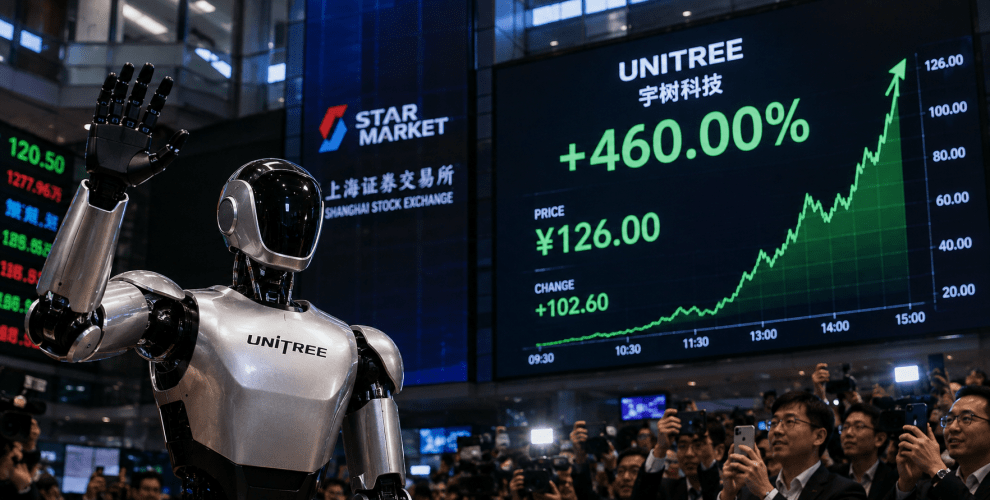
Unitree Stock Jumps 460% in Shanghai Debut as Humanoid Robot Hype Grows
Table of Contents
Unitree Stock Jumps 460% in Shanghai Debut as Humanoid Robot Hype Grows
Chinese robotics company Unitree made a dramatic entrance onto the public market, with its shares soaring as much as 629% during its first day of trading on Shanghai’s STAR Market.
The stock eventually closed at 845 yuan, about 460% above its IPO price of 150.80 yuan. The debut highlights just how strongly investors are betting on humanoid robotics becoming one of China’s next major technology industries.
Key Takeaways
- Unitree shares climbed as much as 629% during their Shanghai market debut.
- The stock finished its first trading day approximately 460% above its IPO price.
- Unitree raised around 6.1 billion yuan ($904 million) through the IPO.
- The company develops both humanoid and four-legged robots.
- Unitree reported roughly 1.7 billion yuan in 2025 revenue.
- In 2025, foreign markets accounted for more than 40% of company sales.
How Much Did Unitree Stock Rise?
Unitree entered the STAR Market at an IPO price of 150.80 yuan per share.
At one point during its debut, the stock reached around 1,100 yuan, representing a gain of roughly 629%. It later pulled back and closed at 845 yuan, still leaving IPO investors with a first-day increase of around 460%.
Demand had already been unusually strong before trading began. Retail orders exceeded the shares available to them by more than 8,000 times, demonstrating intense investor interest in China’s robotics sector.
What Does Unitree Robotics Make?
Founded in 2016, Unitree is a robotics firm located in Hangzhou.
It first became widely known for its affordable quadruped robots, often described as robot dogs. The company has since expanded aggressively into humanoid machines capable of walking, running, dancing and performing complex movements.
Videos showing Unitree robots performing martial arts and other highly coordinated movements have helped the company gain attention far beyond China.
The company competes in the broader humanoid robotics market with companies including Tesla and Boston Dynamics.
Is Unitree Already Making Money?
Unlike many early-stage robotics companies, Unitree has already generated meaningful revenue.
The company reported around 1.7 billion yuan ($250 million) in revenue for 2025, with more than 40% coming from international sales.
However, today’s excitement around Unitree is based heavily on expectations for what humanoid robots could eventually become.
Real-world deployment of general-purpose humanoids remains limited, and many robots are still used for research, demonstrations and specialized applications rather than everyday commercial work.
Why Are Investors Excited About Humanoid Robots?
Investors increasingly see robotics as the next stage of artificial intelligence.
Generative AI mainly works through software. Humanoid robots attempt to bring AI into the physical world, allowing machines to understand instructions and perform real-world tasks.
Unitree CEO Wang Xingxing believes robotics could eventually experience its own “ChatGPT moment,” when improvements in AI allow robots to perform unfamiliar tasks after receiving simple instructions. However, he cautioned that the software breakthrough required could still be years away.
China is investing heavily in this opportunity. More than 40,000 humanoid robots were delivered in China during the first half of 2026, according to figures cited by Reuters.
What Will Unitree Do With Its IPO Money?
Unitree raised approximately 6.1 billion yuan, or around $904 million, from the offering.
The company plans to direct the proceeds toward research and development and expanding its manufacturing capacity.
Those investments could help Unitree improve both the intelligence and physical capabilities of its robots while preparing for larger-scale production.
China’s strong manufacturing ecosystem may also provide an advantage as robotics companies attempt to reduce hardware costs and move from prototypes toward commercial deployment.
Are There Risks Behind the Unitree Stock Hype?
Yes.
A spectacular first-day stock gain doesn’t necessarily mean humanoid robots are already a mature commercial industry.
Many current humanoid systems remain expensive and limited compared with human workers. At Beijing’s World Robot Conference, companies demonstrated impressive capabilities, but practical tasks still exposed the limitations of today’s technology.
Unitree also faces geopolitical challenges.
The U.S. Federal Communications Commission has introduced restrictions affecting imports of new foreign-made humanoid and quadruped robots over national-security concerns, creating uncertainty around Unitree’s future access to the U.S. market.
So while investors are pricing in substantial future growth, the industry still needs to prove that humanoid robots can deliver practical value at scale.
Why Does Unitree’s IPO Matter for China’s Robotics Industry?
Unitree’s debut provides an important public-market benchmark for China’s rapidly expanding humanoid robotics sector.
Several other Chinese robotics companies are also exploring public listings, meaning Unitree’s performance could influence how investors value the companies that follow.
The IPO also arrives as robotics becomes another major area of technological competition between China and the United States.
China has developed a strong manufacturing advantage in robotics, while U.S. companies continue investing heavily in AI and advanced robot development.
Conclusion
Unitree’s extraordinary stock-market debut shows how much enthusiasm has built around humanoid robotics.
The company already has products, revenue and significant manufacturing experience, but the broader humanoid industry is still developing. Investors are effectively betting that robots will eventually move from demonstrations and research labs into factories, businesses and everyday environments.
Whether that expectation justifies today’s valuations will depend on how quickly the technology becomes genuinely useful at scale.
FAQs
How much did Unitree stock rise on its first trading day?
Unitree shares climbed as much as 629% intraday and finished their first session around 460% above the IPO price.
What was the Unitree IPO price?
Unitree’s IPO was priced at 150.80 yuan per share on Shanghai’s STAR Market.
How much money did Unitree raise from its IPO?
Unitree raised approximately 6.1 billion yuan, or $904 million, through the offering.
What does Unitree Robotics make?
Unitree develops quadruped robot dogs and humanoid robots capable of movements such as walking, running and performing complex physical actions.
Is Unitree profitable?
Unitree has reported profits alongside growing revenue. In 2025, the company generated roughly 1.7 billion yuan in revenue.
Why is Unitree’s IPO important?
The listing gives investors a major publicly traded company through which to gain exposure to China’s growing humanoid robotics industry and could help establish valuations for other robotics companies planning IPOs.