
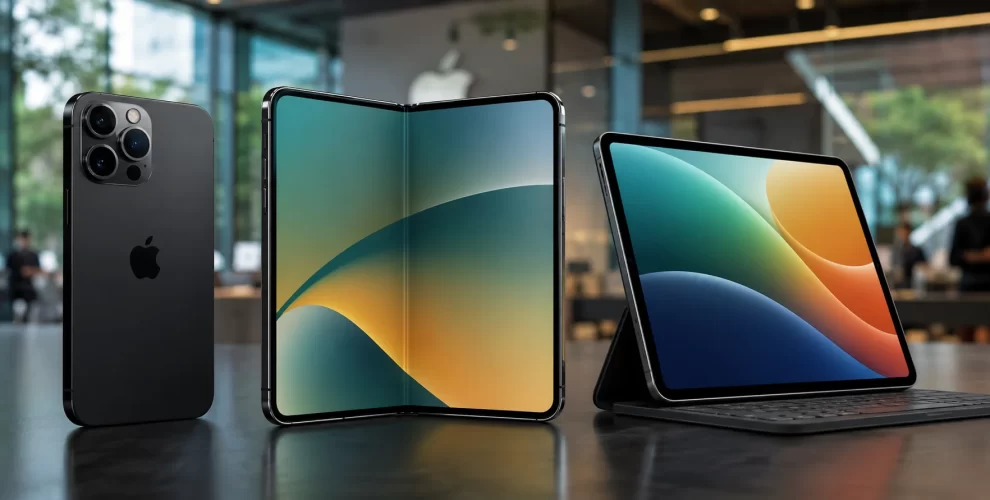
Apple’s Foldable iPhone Has an Identity Problem — Is It a Phone or an iPad?
Table of Contents
Apple’s Foldable iPhone Has an Identity Problem — Is It a Phone or an iPad?
Apple’s long-awaited entry into the foldable smartphone market could introduce a very different kind of iPhone. Reports suggest the company is working on a premium foldable device that behaves like a conventional smartphone when closed but opens into a much larger, tablet-like display.
That sounds exciting, but it also raises an important question: where does this device actually fit in Apple’s product lineup?
If the rumored design becomes reality, Apple’s foldable could sit directly between the iPhone and iPad mini. That unusual position may become its biggest selling point—or its biggest weakness.
Key Takeaways
- Apple is widely expected to enter the foldable smartphone market in 2026.
- Reports suggest the device could carry the iPhone Ultra name.
- The rumored design includes a roughly 5.5-inch outer display and a 7.8-inch inner display.
- The unfolded screen could use a tablet-like 4:3 format.
- Apple may introduce software features designed specifically for the larger folding screen.
- Touch ID could potentially replace Face ID.
- The device may use two rear cameras rather than a dedicated telephoto camera.
- Current price estimates range from approximately $2,000 to $2,500.
- Apple has not officially confirmed the device, specifications, pricing, or release date.
What Could Apple’s Foldable iPhone Be?
Apple is reportedly preparing a book-style foldable smartphone for its premium iPhone range.
In its folded state, the device is expected to offer a display of around 5.5 inches, making it suitable for everyday smartphone activities such as messaging, calls, browsing and social media. Open the device, however, and the experience could change dramatically with a screen measuring close to 7.8 inches.
This design creates a unique proposition. Instead of carrying a phone and a small tablet separately, users could potentially have both experiences in a single device.
But that convenience comes with an obvious question: is Apple creating a new category, or simply combining two existing ones?
Why Does the Foldable iPhone Have an Identity Problem?
Apple already has clearly defined roles for its major mobile products.
The iPhone focuses on portability and everyday communication, while the iPad provides a larger workspace for reading, entertainment, productivity and multitasking.
A foldable iPhone could blur those boundaries.
The rumored internal display is expected to use a 4:3-style aspect ratio, similar to the proportions associated with an iPad. Apple may also adapt iOS with features such as side panels and the ability to display two apps simultaneously.
That creates an interesting dilemma:
Is it an iPhone that becomes bigger, or a small iPad that happens to make phone calls?
How Apple answers that question could determine whether consumers see the foldable as genuinely useful or simply as an extremely expensive experiment.
What Could the iPhone Ultra Look Like?
Current reports describe a foldable that could be wider and shorter than some of the taller foldable smartphones already available.
The rumored specifications include:
- Around 5.5 inches for the external screen
- Approximately 7.8 inches for the unfolded display
- Around 4.5mm thick when opened
- Roughly 9mm to 9.5mm thick when folded
Apple is also reportedly paying close attention to the folding mechanism and display crease. A less noticeable crease could be an important part of making the device feel premium rather than experimental.
The wider internal screen could also give Apple’s design a distinct look compared with competing foldables.
Will It Use iOS or iPadOS?
Despite the larger display, current reports indicate that the foldable will run iOS rather than iPadOS.
However, Apple may modify the operating system to take better advantage of the additional screen real estate. Possible changes include app sidebars, improved multitasking and support for displaying multiple applications at the same time. Developers may also receive tools to make their apps work effectively across the two screen sizes.
This could be more important than the hardware itself.
A folding screen alone does not automatically create a better user experience. Apple needs to make the additional display genuinely useful. If apps simply become larger without providing meaningful functionality, users may struggle to see why the device deserves its premium price.
Could It Replace an iPad Mini?
For certain users, the answer could be yes—but probably not completely.
A 7.8-inch internal display would put the foldable close to the size of Apple’s compact tablet category. It could be particularly attractive for people who mainly use a small tablet for reading, browsing, watching videos or handling basic multitasking.
However, the reported device is expected to remain an iPhone running iOS rather than becoming a full iPadOS device.
That distinction matters.
The foldable could reproduce some of the convenience of a small tablet without actually replacing the iPad mini for users who rely heavily on tablet-specific applications and workflows.
Its biggest advantage may therefore be convenience rather than complete replacement.
What Features Could Apple Sacrifice?
The biggest challenge with making a foldable extremely thin is fitting all the necessary hardware inside its compact body.
Reports suggest Apple could make some unusual compromises. The device may feature two 48MP rear cameras but potentially skip a dedicated telephoto camera. There is also speculation that Apple could use Touch ID instead of Face ID to save internal space.
That creates an interesting contradiction.
If Apple positions the device as an “Ultra” model, consumers will naturally expect it to offer the company’s best features across the board. Paying more than an iPhone Pro Max while receiving fewer camera capabilities could make the pricing harder to justify.
Apple therefore needs the foldable display and overall experience to provide enough value to compensate for those compromises.
How Powerful Could Apple’s Foldable Be?
Performance does not appear to be the area where Apple intends to cut corners.
Current reports suggest the device could use an A20-series processor, potentially manufactured using TSMC’s 2nm technology. The combination could provide strong performance while improving efficiency.
Battery capacity is also rumored to be in the region of 5,400–5,800mAh.
That would be significant because a large internal display can consume substantially more power than a traditional smartphone screen. Efficient processing and a large battery could therefore be essential to making the foldable practical for everyday use.
How Much Could Apple’s Foldable iPhone Cost?
Price may ultimately be the biggest barrier.
Current estimates place the device somewhere around $2,000 to $2,500, with higher-storage versions potentially costing even more. Apple, however, has not announced official pricing.
At that price, consumers will expect more than a conventional iPhone with a folding display.
The value proposition becomes much easier to understand if buyers think of it as:
An iPhone and compact tablet in one device.
The proposition becomes considerably weaker if consumers see it as:
A very expensive iPhone with fewer camera features.
That perception could have a major impact on demand.
Why Has Apple Taken So Long to Enter the Foldable Market?
Apple would be entering a market where Android manufacturers have already gained years of experience.
Companies such as Samsung and other Android brands have gone through multiple generations of foldable devices, allowing them to improve hinge systems, flexible displays, durability and software integration.
Apple’s slower approach could work in its favor.
Rather than rushing to market, the company appears to be focusing on areas such as hinge durability, display crease reduction and an exceptionally thin design.
If Apple can deliver a first-generation foldable that feels refined and reliable, waiting could prove to have been a strategic advantage.
The downside is equally clear: expectations will be extremely high.
Is “iPhone Ultra” the Right Name?
Even the rumored name highlights the device’s identity challenge.
Apple has not confirmed the name, but reports have increasingly pointed toward iPhone Ultra rather than a name such as iPhone Fold. The device could reportedly sit above the iPhone 18 Pro Max in Apple’s lineup.
The word “Ultra” immediately suggests a top-tier product.
Consumers may therefore expect the best cameras, the most advanced authentication system and the fewest compromises.
But if Apple prioritizes the folding design and slim profile at the expense of certain flagship features, the Ultra branding could create expectations that the hardware cannot fully meet.
Could Apple Still Make the Foldable Work?
Absolutely—but the software experience could be the deciding factor.
Reports suggest early testers have responded positively to aspects such as the compact design, hinge and interface built around the larger internal display.
Apple also has a major advantage that many competitors cannot easily replicate: its ecosystem.
If applications can smoothly transition between the outside and inside screens, users may feel that the foldable is more than a conventional iPhone with an unusual hinge.
The real breakthrough could come from software that makes changing screen sizes feel natural.
In other words, the folding mechanism may attract attention, but the software could determine whether people actually want to live with the device.
Why Apple’s Foldable iPhone Matters
Apple entering the foldable market would be significant even if the first generation remains a niche product.
The company has a huge global iPhone user base and considerable influence over software developers. If Apple introduces new interfaces and development tools for foldable screens, developers may have greater motivation to create applications that adapt to changing display sizes.
That could have consequences beyond Apple itself.
A successful Apple foldable could encourage more companies to invest in flexible-screen devices and could push developers to think differently about how mobile applications respond to screen size and orientation.
Final Verdict: Phone, iPad or Something New?
Apple’s first foldable iPhone could represent one of the company’s most significant changes to the iPhone formula in years.
But the biggest challenge is not whether Apple can build a folding phone. It is whether Apple can clearly explain why people need one.
If the rumored iPhone Ultra successfully combines the portability of an iPhone with the workspace of a compact tablet, its unusual position could become its greatest advantage.
However, if consumers pay more than $2,000 and receive fewer camera features than an iPhone Pro Max while still missing the full capabilities of an iPad, the value proposition becomes much harder to defend.
The hardware may be impressive, but Apple’s real challenge will be creating a compelling reason to choose one expensive foldable device instead of owning an iPhone and an iPad separately.
Frequently Asked Questions
1. What is Apple’s foldable iPhone?
Apple is reportedly developing a book-style foldable iPhone with a conventional outer display and a larger internal screen that opens into a tablet-like format.
2. Will Apple’s foldable be called the iPhone Ultra?
Apple has not confirmed the name. However, current reports suggest that iPhone Ultra could be the branding used for the device.
3. How large could the foldable iPhone display be?
Reports currently point to an outer display of approximately 5.5 inches and an internal folding display of around 7.8 inches.
4. Will the foldable iPhone run iPadOS?
Current reports suggest it will use iOS, with additional software features designed to take advantage of the larger folding screen.
5. Could Apple replace Face ID with Touch ID?
There is speculation that Apple could use Touch ID instead of Face ID because of the space required for Face ID hardware in a very thin foldable design.
6. How much could Apple’s foldable iPhone cost?
Current estimates place the expected price around $2,000–$2,500, although Apple has not announced official pricing.
7. When could Apple launch its foldable iPhone?
The device is widely expected to arrive in fall 2026, potentially alongside the iPhone 18 Pro lineup. Apple has not officially confirmed the launch date.
Want to keep up with our blog?
Our most valuable tips right inside your inbox, once per month.
Related Post




Previous
Claude Opus Reverse-Engineered PC Accessories in Hours — and That Raises a Security WarningNext