
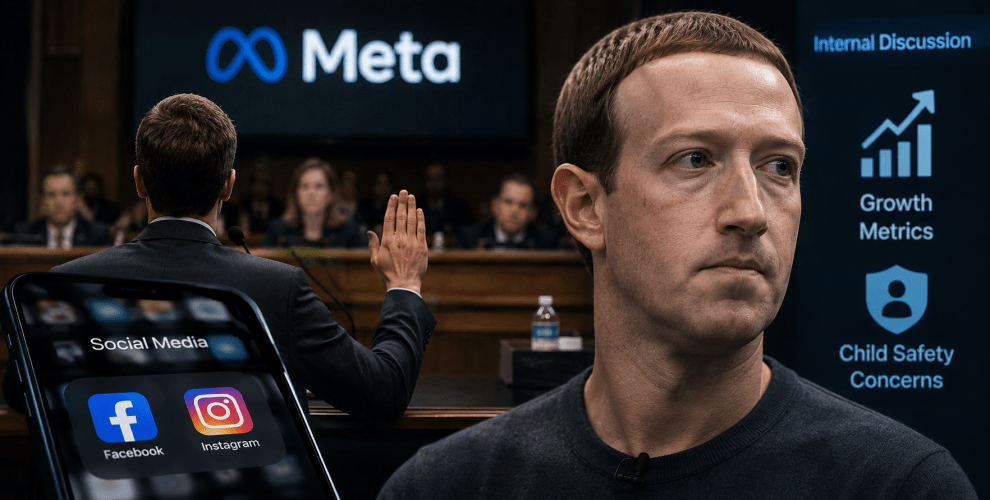
Former Meta Engineer Says Zuckerberg Put Growth Ahead of Child Safety
Table of Contents
Former Meta Engineer Says Zuckerberg Put Growth Ahead of Child Safety
A former Meta engineering director has told a federal court that Mark Zuckerberg prioritized growth and user engagement over child safety on Facebook and Instagram.
Arturo Béjar, who previously worked at Meta and later returned as a contractor, gave the testimony during a major trial in Oakland, California. The case is part of a broader legal action involving 29 U.S. states that accuse Meta of designing its platforms in ways that encouraged compulsive use among young people. Meta disputes those allegations.
Key Takeaways
- Former Meta engineering director Arturo Béjar testified about the company’s approach to youth safety.
- Béjar alleged that Mark Zuckerberg’s focus on growth influenced how safety concerns were handled.
- He said Meta knew about harmful experiences affecting teenagers but did not respond strongly enough.
- Béjar also questioned how Meta dealt with children under 13 using Instagram.
- Meta says it has invested heavily in safety and introduced stronger protections for teenagers.
- The wider case involves 29 state attorneys general and could result in financial penalties and changes to Meta’s platforms.
Who Is Arturo Béjar?
Arturo Béjar is a former Meta engineering director who worked at the company from 2009 to 2015 and later returned as a contractor.
His responsibilities included work related to user safety. He has also previously testified before the U.S. Congress about the experiences of young people on Instagram.
Béjar has now become an important witness for the states challenging Meta because his testimony focuses on what employees allegedly knew internally about problems affecting younger users.
What Did the Former Meta Engineer Say About Zuckerberg?
Béjar testified that decisions made by CEO Mark Zuckerberg had a major influence on Meta’s internal priorities.
According to Béjar, the company placed strong importance on growth and engagement, while some proposals intended to improve user safety struggled to receive the same level of attention.
His testimony supports the states’ broader argument that Meta’s business incentives influenced how Facebook and Instagram were designed.
Meta rejects the claim that it intentionally created harmful or addictive products for children. The company has argued that the states are overlooking years of work devoted to youth safety.
What Did Béjar Say About Children Under 13?
Another major part of Béjar’s testimony involved Instagram users who were younger than the platform’s minimum age.
Meta requires users to be at least 13 years old to use Instagram and Facebook.
Béjar alleged that the company historically did too little to proactively identify underage users, describing its past approach as effectively avoiding information that could reveal a user was under 13.
Meta’s current policies are different. The company says it now uses AI and other signals to identify suspected underage accounts and remove users it believes are younger than 13.
Did Meta Know Teenagers Were Having Harmful Experiences?
Béjar testified that internal research and feedback showed teenagers were encountering harmful experiences on Meta’s platforms.
He also discussed his own family’s experience after his daughter received abusive messages on Instagram. According to his testimony, these experiences helped convince him that existing safety systems weren’t doing enough.
The states argue that such internal knowledge is important because their case isn’t simply about whether harmful content existed. They are trying to establish what Meta knew, how it responded, and whether business priorities affected those decisions.
What Safety Features Does Meta Have for Teenagers Today?
Meta says its platforms have changed significantly.
Its Teen Accounts automatically apply protections intended to limit inappropriate content and unwanted contact. Younger teens also need parental permission to weaken certain protections.
In 2026, Meta expanded AI-based age assurance and its 13+ content settings across more countries and services. The company says these systems can identify accounts suspected of belonging to teenagers even when users enter an adult birthday.
Why Is This Testimony Important?
Béjar is significant to the states’ case because he isn’t an outside critic. He worked inside Meta and had direct experience with safety issues.
The trial centers on whether Meta designed Facebook and Instagram in ways that exploited younger users while misleading consumers about safety.
Four states—California, Colorado, Kentucky and New Jersey—are presenting state-law claims together in the current trial, while the broader litigation involves 29 state attorneys general.
The court could ultimately impose substantial penalties and require changes to how Meta operates its platforms if the states succeed.
Who Will Decide the Meta Trial?
The proceedings have an unusual structure.
U.S. District Judge Yvonne Gonzalez Rogers selected an eight-person advisory jury. The jury can provide its view of the evidence, but its decision will not be binding.
The final decision remains with the judge.
That makes the advisory jury influential but not ultimately responsible for deciding Meta’s legal fate.
What Happens Next?
Béjar’s testimony is only one part of a trial expected to continue for several weeks.
The court is expected to hear additional evidence about Meta’s internal decisions, platform design and youth-safety practices. Senior Meta executives, including Zuckerberg, are also expected to play an important role in the proceedings.
The outcome could affect more than Facebook and Instagram. Other social platforms are facing similar questions about whether product design can contribute to harmful or compulsive behavior among young users.
Conclusion
Arturo Béjar’s testimony gives the states an insider perspective for their argument that Meta placed engagement and growth ahead of protecting younger users.
Meta strongly disputes that characterization and points to the extensive protections it has introduced for teenagers.
The court will now have to consider those competing accounts as it decides whether Meta’s past practices violated the law and whether further changes to Facebook and Instagram are necessary.
FAQs
1. Who is Arturo Béjar?
Arturo Béjar is a former Meta engineering director who worked on user-safety issues and later returned to the company as a contractor. He is now testifying in the states’ case against Meta.
2. What did Arturo Béjar say about Mark Zuckerberg?
Béjar alleged that Zuckerberg prioritized company growth and user engagement and that this influenced Meta’s approach to safety improvements.
3. What did the former Meta engineer say about children under 13?
Béjar alleged that Meta historically did not do enough to proactively identify children younger than 13 using its platforms. Meta says its current systems use AI and other signals to detect and remove suspected underage accounts.
4. What is Meta accused of in the current trial?
The states accuse Meta of designing Facebook and Instagram to encourage compulsive use among children, misleading consumers about safety, and improperly handling data involving users under 13. Meta denies the allegations.
5. What safety features does Meta currently provide for teenagers?
Meta has introduced Teen Accounts, stricter content settings, parental controls and technology designed to identify users who may be misrepresenting their age.
6. Has Meta been found liable in this trial?
No. The Oakland trial is ongoing, and the allegations discussed in Béjar’s testimony have not yet resulted in a final ruling in this case.