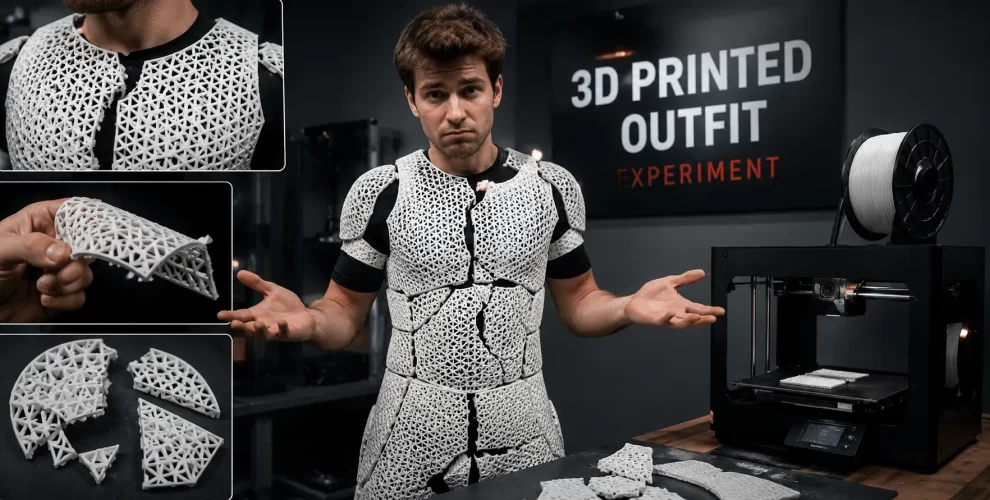
YouTuber Creates a Fully 3D-Printed Outfit, but the Results Show the Limits of Wearable Printing
A YouTuber has taken 3D printing to a new level by creating an entire outfit using a collection of 3D printers.
From clothing and shoes to accessories, the project demonstrates just how far consumer 3D printing has come.
However, it also highlights that turning printed designs into practical everyday clothing is still a major challenge.
The outfit included several wearable items such as a shirt, shoes, socks, a belt, a hat, a bag, a wallet, a tie, and glasses.
While some pieces turned out surprisingly well, others were less successful due to design limitations and the rigid nature of printed materials.
The experiment showed that creating wearable fashion with a 3D printer is possible, but comfort and flexibility remain difficult to achieve.
The project also required a significant investment of both time and money.
Although the printing material itself was relatively affordable, specialized 3D printers were needed to produce some of the larger items.
In addition, designing, preparing, and printing every piece took hundreds of hours before the final outfit was ready to wear.
Despite the impressive achievement, the experiment makes it clear that 3D-printed clothing is not yet a practical replacement for traditional fabrics.
Printed garments can be creative, customizable, and useful for demonstrations, costumes, or artistic projects, but they still struggle to match the comfort, durability, and flexibility of everyday clothing.
Projects like this continue to push the boundaries of what personal 3D printing can accomplish.
As printing materials and technology continue to improve, wearable 3D-printed fashion may become more practical in the future.
For now, however, it remains an exciting showcase of creativity rather than a realistic alternative to buying clothes from a store.
Overall, the project proves that a fully 3D-printed outfit is possible, but it also reminds us that innovation often comes with trade-offs.
While the results are impressive from a technical perspective, everyday comfort, printing time, and equipment costs still make this more of an experimental achievement than a practical fashion solution.