Your Private ChatGPT Conversations Could End Up in Court
Table of Contents
Your Private ChatGPT Conversations Could End Up in Court
People increasingly use AI chatbots for more than simple questions. They discuss relationships, work problems, health concerns, legal situations and other deeply personal topics.
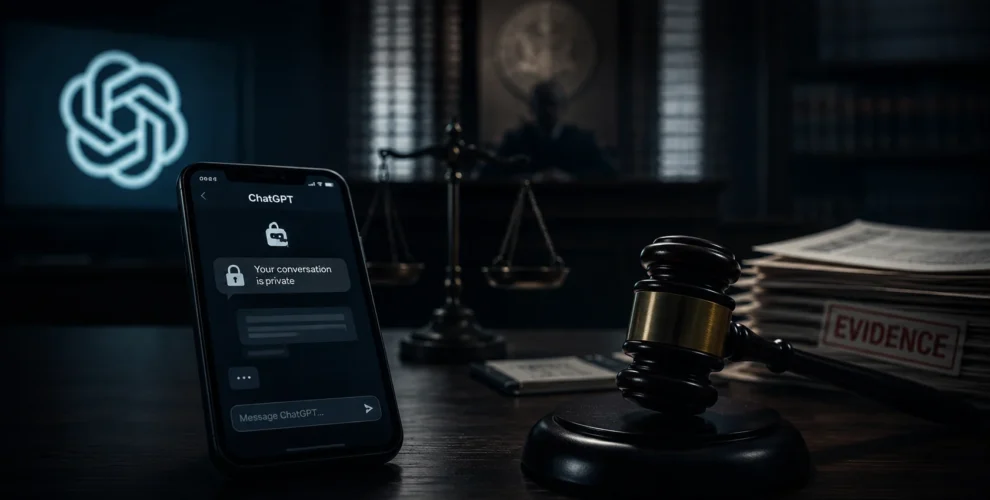
But there is an important privacy issue many users may not realize: a conversation with ChatGPT does not automatically receive the same legal protection as a conversation with a lawyer or doctor.
A recent review by The Washington Post found chatbot conversations referenced in 12 civil and criminal court cases over the past two years, showing that AI chat histories are beginning to emerge as a new form of digital evidence.
Key Takeaways
- Chatbot conversations have already appeared in civil and criminal court cases.
- AI chats generally don’t have the same legal privilege as conversations with an attorney.
- Chat histories can contain detailed information about a person’s intentions, thoughts and decisions.
- Police may sometimes obtain chats through access to a person’s device or through valid legal processes.
- Civil litigants can also seek user data through subpoenas or court orders.
- Deleting a chat or using Temporary Chat does not guarantee that information can never be retained for legal reasons.
- Courts are still developing rules around when AI conversations are protected or discoverable.
Why Are ChatGPT Conversations Appearing in Court?
Chatbot conversations can contain unusually detailed personal information.
Unlike a typical Google search, where someone might enter only a few keywords, a ChatGPT conversation can involve long explanations, follow-up questions and descriptions of someone’s reasoning.
That can make the conversation potentially useful as evidence.
The Washington Post identified cases involving criminal proceedings, civil disputes and other legal matters where chatbot conversations became relevant.
Are ChatGPT Conversations Legally Private?
Not in the same way as certain professionally privileged conversations.
For example, communications between a person and their lawyer can qualify for attorney-client privilege when the legal requirements are met.
Ordinary conversations with an AI chatbot generally do not receive that protection.
A federal court highlighted this issue in a case involving financial executive Bradley Heppner, who used Anthropic’s Claude while preparing to discuss his legal situation with attorneys. The judge ruled that those AI conversations were not protected by attorney-client privilege under the circumstances of that case.
Importantly, courts have not treated every AI conversation identically. Another case discussed by the American Bar Association found that some ChatGPT material could qualify for work-product protection under different circumstances.
So the legal status can depend heavily on the facts of each case.
How Can AI Chats Become Evidence?
There are several possible routes.
In some criminal investigations, police obtain chatbot conversations after gaining lawful access to a person’s phone or computer. People may also voluntarily allow officers to inspect their devices.
In civil lawsuits, attorneys can seek digital records through the discovery process.
OpenAI’s own policy confirms that it accepts valid civil requests for user information, including subpoenas and court orders. The company says it reviews such requests and provides information only when permitted under applicable law.
OpenAI also says it will notify affected users before disclosure when legally possible and appropriate.
Does Deleting a Chat Completely Remove It?
Users can delete individual ChatGPT conversations, and Temporary Chat provides additional privacy controls.
However, deletion should not be interpreted as a guarantee that information can never be retained.
OpenAI may retain certain information for longer when required for security or legal reasons.
This means users shouldn’t rely on deleting a conversation afterward as their primary privacy strategy.
The safer approach is to think carefully before entering highly sensitive information into any AI service.
Why Are AI Chats Different From Search History?
A search history might reveal what someone was researching.
An AI conversation can reveal much more context.
Users may explain what happened, why they are worried, what they intend to do and how they feel about a situation. They may then continue discussing the subject through dozens of follow-up messages.
That creates a much richer record of someone’s thinking.
Legal experts therefore see chatbot histories as potentially valuable digital evidence in ways that ordinary search histories may not be.
Is OpenAI Asking for Stronger Privacy Protection?
Yes.
OpenAI CEO Sam Altman has previously argued that sensitive AI conversations should eventually receive stronger legal protections similar to those surrounding certain conversations with doctors or lawyers.
The idea is sometimes described as creating a form of AI privilege.
But that broad legal protection does not currently exist for ordinary chatbot conversations.
OpenAI has also publicly challenged demands it believes are excessively broad. In one copyright dispute, the company opposed a request involving millions of private ChatGPT conversations, arguing that it threatened user privacy.
Should You Stop Using ChatGPT for Personal Topics?
Not necessarily.
The growing use of chatbot records in legal proceedings doesn’t mean everyone’s conversations are being routinely reviewed or sent to courts.
The practical lesson is simpler: don’t assume an AI conversation has legal confidentiality simply because it feels private.
For highly sensitive legal matters, users should consider speaking directly with a qualified attorney rather than treating an AI chatbot as a legally privileged replacement.
Similarly, avoiding unnecessary names, account details, confidential company information and other identifying data can reduce what is exposed if records ever become relevant.
What Does This Mean for AI Privacy?
As AI assistants become more personal, the difference between technical privacy and legal privilege is becoming increasingly important.
People may feel comfortable telling an AI things they would never post publicly.
But courts, lawmakers and technology companies are still determining how those conversations should be treated when they become relevant to investigations or lawsuits.
Until clearer protections emerge, users should treat sensitive AI conversations with the same caution they would apply to other stored digital records.
Conclusion
ChatGPT can feel like a private space because conversations happen one-on-one with an AI assistant.
Legally, however, that doesn’t automatically make those conversations confidential or privileged.
With chatbot records already appearing in court cases, users should understand that highly personal conversations can potentially become relevant evidence under certain circumstances.
The simplest rule is worth remembering:
If information could seriously affect you if it became part of a legal proceeding, think carefully before putting it into an AI chatbot.
FAQs
1. Can ChatGPT conversations be used in court?
Yes. Chatbot conversations have already appeared as evidence in both civil and criminal proceedings in the United States.
2. Are ChatGPT conversations protected by attorney-client privilege?
Ordinary ChatGPT conversations generally don’t automatically receive attorney-client privilege. Courts determine protection based on the specific circumstances.
3. Can police access ChatGPT conversations?
They may be able to obtain relevant digital information through lawful processes or by accessing a device with the owner’s consent, depending on the circumstances.
4. Can ChatGPT data be requested in a civil lawsuit?
Yes. OpenAI publishes procedures for valid civil requests for user data, including subpoenas and court orders.
5. Does deleting a ChatGPT conversation guarantee it is permanently gone?
No. Certain information may need to be retained longer when required for legal or security reasons.
6. Does ChatGPT have the same confidentiality as talking to a lawyer?
No. A normal AI conversation does not currently have the same established legal privilege as qualifying communications between a lawyer and client.