
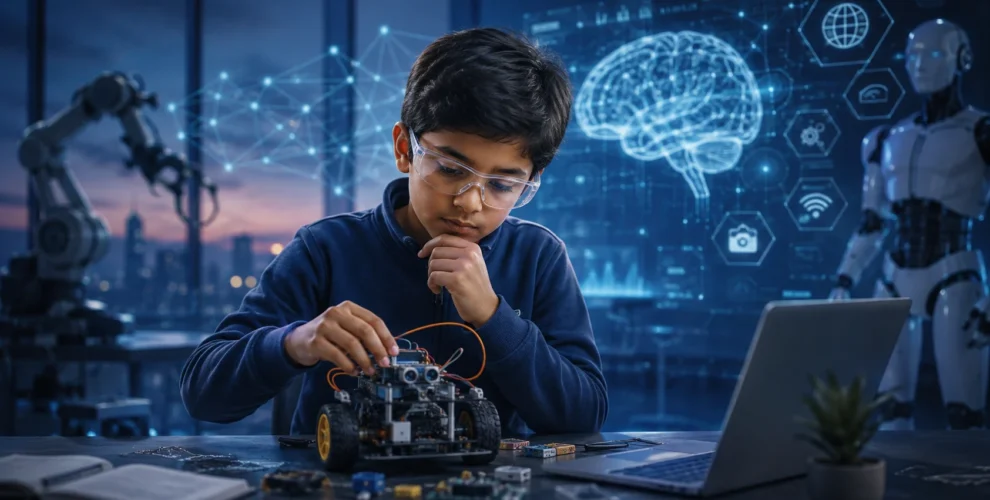
Why Kids Need an Engineer’s Mindset More Than Ever in the AI Era
Table of Contents
Why Kids Need an Engineer’s Mindset More Than Ever in the AI Era
Artificial intelligence is transforming the way people learn, work, and approach problem-solving. For children growing up today, the challenge isn’t simply learning how to use the latest AI tools.
It is learning how to think when there isn’t an obvious answer.
That idea is at the center of a recent conversation with Rachele Harmuth, Chief Product Officer at CrunchLabs, the STEM education company founded by former NASA engineer and YouTube creator Mark Rober. Her argument is that children can prepare for an uncertain AI-driven future by learning to “think like an engineer” — experimenting, solving problems and becoming comfortable when the first attempt doesn’t work.
Key Takeaways
- AI could change which skills are valuable by the time today’s children enter the workforce.
- Teaching one specific technical skill may not be enough to prepare kids for that future.
- Problem-solving, curiosity, judgment, adaptability and perseverance could remain valuable even as technology changes.
- Thinking like an engineer means identifying a problem, testing ideas, learning from mistakes and trying again.
- Failure can be an important part of learning rather than something children should always avoid.
- Parents can encourage resilience by giving children room to solve appropriate problems independently.
- AI may provide answers quickly, but humans still need to judge those answers and decide which problems are worth solving.
Why Is AI Changing What Kids Need to Learn?
Traditional education has placed significant value on remembering information and mastering established processes.
Those skills still matter, but generative AI can now perform many tasks that previously required people to recall information, summarize material, write content or follow defined procedures.
That creates a different challenge for today’s children.
Nobody can confidently predict what the job market will look like when an eight-year-old today begins working 15 or 20 years from now. Some future careers may not even exist yet.
Instead of preparing children for one specific future job, it may be more useful to strengthen skills that can work across many situations.
What Does It Mean to “Think Like an Engineer”?
It doesn’t mean every child needs to become an engineer.
In this context, engineering is a problem-solving mindset.
A child encounters a problem, considers different solutions, tries one, observes what happens and changes the approach when necessary.
The important part isn’t always getting the correct result immediately.
It’s understanding how to reach a better result after something goes wrong.
CrunchLabs uses hands-on projects to encourage this process, with children learning through building, testing and improving their ideas.
Why Can Failure Be Good for Kids?
Parents naturally want to help when children struggle.
But immediately solving every difficult problem for them can sometimes remove an important learning opportunity.
Failure gives children a chance to ask questions such as:
What went wrong? What can I change? What should I try next?
Kids already experience this naturally in video games. Losing a level rarely means they immediately stop playing. Instead, they restart, change their strategy and try again.
Applying the same attitude to learning can help children become more comfortable with mistakes.
The goal isn’t to encourage failure for its own sake. It’s to teach children that one unsuccessful attempt doesn’t mean they are incapable of solving the problem.
Can Resilience Be Learned?
Harmuth argues that resilience shouldn’t simply be viewed as something a person either has or doesn’t have.
It can develop through repeated experiences involving problem-solving, perseverance and adaptability.
Engineering projects aren’t the only way to practice these skills.
Learning an instrument, cooking something new, writing a story, building something, solving puzzles or practicing a difficult sport can create similar experiences.
When something doesn’t work, children need to understand the problem, adjust their approach and try again.
Over time, that process can make unfamiliar challenges feel less intimidating.
Why Does This Matter More in the Age of AI?
AI is becoming increasingly good at providing answers.
But getting an answer isn’t the same as understanding a problem.
Humans still need to determine whether an AI-generated answer is accurate, whether it makes sense in the situation and what should happen next.
That makes judgment and critical thinking increasingly important.
Research and discussions around AI education have raised similar concerns: when technology can perform work for students, education may need to put greater emphasis on active learning and independent thinking rather than simply producing the correct answer.
A child who automatically accepts whatever AI produces may struggle when the AI is wrong.
A child trained to question, test and improve ideas is better prepared to use AI as a tool rather than depend entirely on it.
Should Kids Learn AI or Engineering?
It doesn’t have to be an either-or choice.
Learning how AI works can certainly be valuable. But teaching children only how to operate today’s AI tools may not prepare them for technologies that haven’t been invented yet.
The stronger foundation is learning how to learn and solve unfamiliar problems.
Engineering-style thinking can complement AI literacy because it encourages children to ask questions, experiment and evaluate results.
These skills can remain useful whether a child eventually becomes an engineer, artist, entrepreneur, teacher, scientist or enters a profession that doesn’t exist today.
What Can Parents Do?
Parents don’t necessarily need expensive robotics equipment or advanced coding knowledge.
Everyday activities can provide opportunities for problem-solving.
Instead of immediately giving a child the solution when something doesn’t work, parents can sometimes encourage them to investigate the problem and think about another approach.
Projects, puzzles, crafts, cooking, building activities, sports and creative hobbies can all provide opportunities to experiment and improve.
The important part is allowing children to experience the full cycle:
Try → fail → understand → adjust → try again.
Preparing Kids for Jobs That Don’t Exist Yet
Predicting the exact careers children will have decades from now is nearly impossible.
Technology moves too quickly.
A better approach may be preparing them to handle change itself.
Curiosity helps children explore unfamiliar ideas. Critical thinking helps them judge information. Creative confidence encourages them to experiment. Resilience helps them continue when an idea fails.
These qualities aren’t tied to one technology or profession.
And that’s precisely why they may become even more important as AI continues to evolve.
Conclusion
Preparing children for the AI era doesn’t mean teaching them to compete with artificial intelligence at everything it can do.
It means developing abilities that help them question, experiment, adapt and solve unfamiliar problems.
Thinking like an engineer provides one useful framework: understand the challenge, develop an idea, test it, learn from the result and improve.
AI tools will change. Jobs will change. The technology children use 20 years from now may look completely different from what exists today.
But knowing how to approach a problem you’ve never seen before is unlikely to lose its value.
FAQs
1. What does thinking like an engineer mean for kids?
It means approaching problems by exploring possible solutions, testing ideas, learning from mistakes and improving the approach rather than expecting to succeed immediately.
2. Why is engineering thinking important in the AI age?
AI can generate answers quickly, but children still need critical thinking and judgment to evaluate those answers and solve problems where there isn’t an obvious solution.
3. Does every child need to learn engineering?
No. The idea is not to make every child an engineer. It is to develop transferable skills such as curiosity, problem-solving, adaptability and perseverance.
4. Is failure useful for children’s learning?
Failure can be useful when children have a safe opportunity to understand what went wrong, change their strategy and try again.
5. Will AI make traditional learning skills unnecessary?
No. Knowledge remains important, but AI increases the value of skills such as judgment, critical thinking, creativity and independent problem-solving.
6. How can parents teach problem-solving skills?
Parents can use everyday activities such as puzzles, building projects, cooking, sports and creative hobbies while giving children appropriate space to work through difficulties independently.
Want to keep up with our blog?
Our most valuable tips right inside your inbox, once per month.
Related Post