Anthropic Wins Court Fight Over Pentagon’s “Supply Chain Risk” Blacklist
Table of Contents
Anthropic Wins Court Fight Over Pentagon’s “Supply Chain Risk” Blacklist
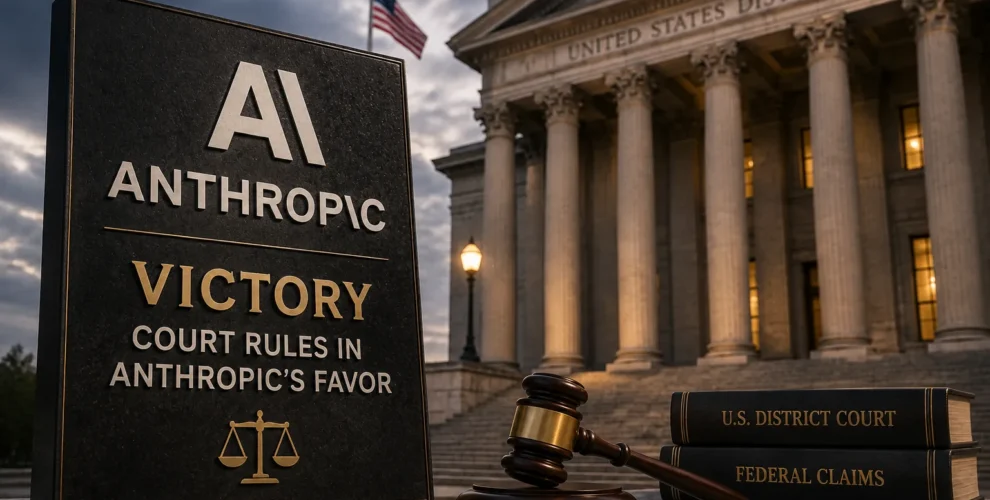
Anthropic has scored an important legal victory in its dispute with the U.S. government.
A federal judge ruled that the Pentagon acted unlawfully when it labeled the Claude maker a “supply chain risk.” The court found that the government’s actions amounted to retaliation against Anthropic for publicly challenging how the military wanted to use its AI technology.
The case is important beyond Anthropic because it raises a bigger question for the AI industry: How much control should AI companies have over the military use of their models?
Key Takeaways
- A federal judge ruled in favor of Anthropic in its dispute with the Pentagon.
- The Pentagon had designated Anthropic a national security supply chain risk.
- The disagreement centered on military uses of Anthropic’s Claude AI.
- Anthropic opposed using its technology for domestic mass surveillance and fully autonomous lethal weapons.
- Judge Rita F. Lin found that the government’s actions violated Anthropic’s First Amendment rights.
- The court said the supply chain designation was not adequately supported by genuine national security concerns.
- Anthropic still has a separate related legal case pending in Washington, D.C.
Why Did the Pentagon Blacklist Anthropic?
The dispute began over the conditions under which the U.S. military could use Claude.
The Pentagon wanted broader permission to use AI for lawful military purposes. Anthropic, however, maintained two important restrictions: it did not want Claude used for mass surveillance of Americans or lethal autonomous weapons operating without human oversight.
Following failed negotiations, Defense Secretary Pete Hegseth designated Anthropic as a supply chain risk.
That decision affected Anthropic’s ability to work on certain Defense Department projects and prompted the military to begin moving away from its technology.
Why Did Anthropic Sue the Government?
Anthropic argued that the designation wasn’t based on evidence that Claude presented a genuine security threat.
Instead, the company said it was being punished for refusing the Pentagon’s proposed terms and for publicly expressing its concerns about military AI.
Anthropic sued in March, claiming that the government’s actions violated its constitutional rights, including its First Amendment right to free speech.
The company also argued that being publicly classified as a national security risk could damage its reputation and cost it significant business.
What Did the Judge Decide?
U.S. District Judge Rita F. Lin largely sided with Anthropic.
The judge found that the Pentagon’s measures were unlawfully retaliatory and that the government had failed to establish an adequate basis for treating Anthropic like a national security supply chain threat.
The ruling also made an important distinction: the government is free to choose which AI companies it wants to work with, but that freedom does not automatically allow it to impose broader penalties on a company because of its public criticism.
The court ordered the government to withdraw actions connected with the unlawful designation.
Why Are Autonomous Weapons Central to the Dispute?
Anthropic’s position isn’t that Claude should never be used by the military.
The company has been willing to support national security applications while maintaining restrictions around a small number of areas it considers especially risky.
One of those areas is fully autonomous weapons—systems capable of selecting and attacking targets without meaningful human control.
The other major restriction involves using Claude for mass domestic surveillance.
The Pentagon’s position has been that private AI companies should not be able to place restrictions on lawful military operations.
That disagreement turned a contract negotiation into a much broader debate about who ultimately controls how advanced AI is used.
What Does the Ruling Mean for Anthropic?
The ruling removes a major legal obstacle for the company, but the dispute isn’t completely finished.
Anthropic has another related case pending in Washington, D.C., concerning a separate aspect of the Pentagon’s supply chain designation. The government could also challenge the latest California decision.
Anthropic welcomed the ruling and said it remains interested in working with the U.S. government on responsible uses of AI for national security.
Why Does This Matter for Other AI Companies?
The case could influence how future disputes between governments and AI developers are handled.
Companies such as Anthropic, OpenAI, Google and others are developing models powerful enough to play increasingly important roles in defense, intelligence and cybersecurity.
But those companies also maintain their own safety policies.
The Anthropic dispute demonstrates what can happen when a government’s intended use of AI conflicts with the restrictions imposed by the company that created it.
As AI becomes more important to national security, similar disagreements may become increasingly common.
What Happens Next?
The latest ruling is a significant win for Anthropic, but it may not be the final word.
A separate legal challenge remains active, and the government could continue fighting the California decision. Meanwhile, the Defense Department has already been moving toward alternative AI providers.
So while Anthropic won this round, the larger argument over military access to advanced AI remains unresolved.
Conclusion
Anthropic’s victory is about more than whether Claude can be used in government systems.
The case highlights an emerging conflict between AI safety policies, government authority and national security requirements.
The Pentagon wanted broader freedom to use Claude. Anthropic refused to remove restrictions involving domestic mass surveillance and autonomous weapons. The government responded by labeling the company a supply chain risk—and a federal judge has now ruled that response unlawful.
As advanced AI becomes more deeply integrated into defense systems, determining who gets to set the boundaries around its use could become one of the industry’s biggest policy questions.
FAQs
1. Why did the Pentagon designate Anthropic as a supply chain risk?
The designation followed Anthropic’s refusal to permit unrestricted use of Claude for certain military applications, particularly domestic mass surveillance and lethal autonomous weapons.
2. Did Anthropic win its lawsuit against the Pentagon?
Yes. U.S. District Judge Rita F. Lin ruled that the Pentagon’s measures against Anthropic were unlawful and violated its First Amendment rights.
3. What restrictions did Anthropic want for Claude?
Anthropic opposed using Claude for mass surveillance of Americans and fully autonomous lethal weapons without meaningful human oversight.
4. Can the U.S. military still choose another AI company?
Yes. The ruling does not prevent the Pentagon from choosing other AI vendors. The legal issue concerned the broader penalties imposed on Anthropic.
5. Is Anthropic’s legal battle over?
No. A separate related case remains pending in Washington, D.C., and further appeals or legal action are possible.
Want to keep up with our blog?
Our most valuable tips right inside your inbox, once per month.
Related Post