
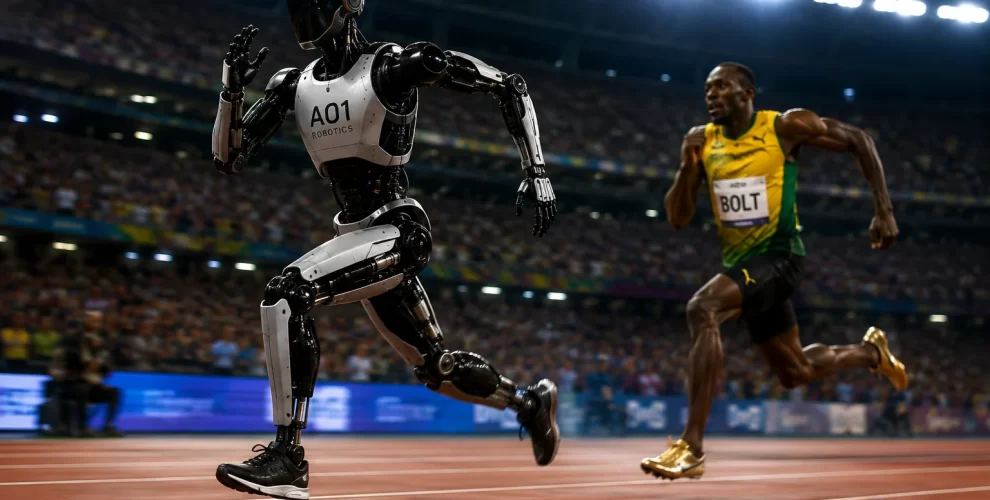
Humanoid Robots Just Ran 100 Meters Faster Than Usain Bolt
Table of Contents
Humanoid Robots Just Ran 100 Meters Faster Than Usain Bolt
Humanoid robots have crossed a striking new milestone in athletic performance.
At the 2026 World Humanoid Robot Games in Beijing, the Tiangong Ultra humanoid completed a 100-meter sprint in 9.39 seconds, faster than Usain Bolt’s 9.58-second human world record. Another robot, Lightning, finished the same heat in 9.47 seconds.
The achievement shows how quickly humanoid robots are improving—but the races also exposed a major weakness: these machines can run extremely fast, yet some still struggle to stop safely.
Key Takeaways
- Tiangong Ultra completed 100 meters in 9.39 seconds.
- Usain Bolt’s official human world record remains 9.58 seconds, set in 2009.
- Honor’s Lightning robot also beat Bolt’s time with a 9.47-second run.
- Lightning reportedly clocked an even faster 9.32 seconds during a pre-race trial.
- More than 2,000 humanoid robots are participating in the Beijing event.
- The competition includes running, jumping, soccer, table tennis, weightlifting and other events.
- Despite their speed, several robots still had difficulty slowing down after crossing the finish line.
Did a Robot Really Beat Usain Bolt’s 100-Meter Record?
Yes—but there is an important distinction.
Usain Bolt ran 100 meters in 9.58 seconds at the 2009 World Championships in Berlin, a record that still stands for human athletes.
At the World Humanoid Robot Games, Tiangong Ultra completed the same distance in 9.39 seconds.
That makes the robot faster over the distance, but it does not replace Bolt’s official athletics world record. Human and robot competitions are obviously separate categories.
Still, comparing the two times provides a remarkable indication of how quickly robotic locomotion is advancing.
What Is Tiangong Ultra?
Tiangong Ultra is a humanoid robot developed by the Beijing Humanoid Robot Innovation Center, also known as X-Humanoid.
During the opening events in Beijing, the robot competed against other humanoid machines in the 100-meter sprint.
It crossed the line in 9.39 seconds, ahead of Lightning at 9.47 seconds.
The performance becomes even more impressive when compared with last year’s competition.
At the inaugural World Humanoid Robot Games in 2025, Tiangong Ultra won the 100-meter race in 21.5 seconds.
Going from 21.5 seconds to under 10 seconds in roughly a year demonstrates the rapid progress being made in robotic movement.
Was There an Even Faster Robot Run?
Yes.
Before the competition officially opened, Honor’s humanoid robot Lightning reportedly completed a 100-meter trial in 9.32 seconds, reaching a peak speed of 14.5 meters per second.
During the actual preliminary race covered by Engadget, however, Tiangong Ultra recorded 9.39 seconds while Lightning finished in 9.47 seconds.
The distinction between trial runs and competition results is important when comparing the reported times.
Can These Robots Stop After Running That Fast?
This is where the technology looks considerably less polished.
Some robots struggled to slow down naturally after completing their races.
Organizers placed large padded barriers beyond the finish line, and footage showed robots crashing into them before being collected by staff. Some machines even needed to be carried away.
So while robots may already be capable of reaching extraordinary running speeds, speed alone doesn’t mean they have human-level mobility.
Reliable braking, balance, turning, obstacle avoidance and recovery after losing stability are equally important for practical humanoid robots.
Did Robots Break Other Human Athletic Records?
The 100-meter sprint wasn’t the only impressive performance.
A humanoid robot also achieved a 2.88-meter standing high jump during the games. AP reports that this exceeded the 2.45-meter human high-jump world record set by Javier Sotomayor, although the robot event was a standing jump and therefore is not directly comparable to conventional human high jump competition.
Tiangong Ultra also posted an extremely fast performance over 400 meters, with reports putting its time below the 43.03-second human world record held by Wayde van Niekerk.
Again, these performances don’t replace official human sporting records. They demonstrate the machines’ rapidly improving physical capabilities.
What Are the World Humanoid Robot Games?
The World Humanoid Robot Games are an Olympics-style competition designed to test and demonstrate humanoid robotics.
The second edition is being held in Beijing’s National Speed Skating Oval, originally built for the 2022 Winter Olympics.
More than 2,000 humanoid robots from teams representing 16 countries are participating this year.
Events include sports such as running, soccer, table tennis, weightlifting and tug-of-war, alongside tasks intended to test capabilities that could eventually be useful outside sports.
Why Are Robot Sports Important?
Watching robots race can look like entertainment, but the engineering behind it has practical applications.
Running requires a humanoid robot to continuously manage balance, foot placement, joint movement, acceleration and changing forces.
Improving those systems could eventually help robots move more reliably through factories, warehouses and other real-world environments.
Competitions also expose weaknesses very quickly.
A robot might achieve an impressive top speed but still fail when asked to stop, turn sharply, recover from a stumble or respond to an unexpected obstacle.
Those failures provide engineers with valuable information about what still needs improvement.
Are Humanoid Robots Ready for Everyday Use?
Not yet.
Despite the eye-catching records, experts quoted by AP note that humanoid robots are still primarily being used for research, demonstrations and performances, rather than widespread everyday deployment.
Running 100 meters quickly is a very different challenge from safely navigating a crowded warehouse or helping someone inside a home.
Real-world robots need reliability, precision, endurance, safety and the ability to respond intelligently when something unexpected happens.
The Beijing races show enormous progress in one part of that equation: physical performance.
Why Is This Important for the Industry of Humanoid Robots?
The speed of improvement may be more significant than the record itself.
A robot beating a famous human sprint time makes a great headline. But Tiangong Ultra’s improvement from a 21.5-second 100-meter race in 2025 to 9.39 seconds in 2026 provides a clearer picture of how rapidly the technology is developing.
China is also investing heavily in humanoid robotics. The World Humanoid Robot Games coincided with the 2026 World Robot Conference in Beijing, where companies displayed thousands of robotics products.
The competition therefore isn’t just about robotic sports. It is also a showcase for a rapidly developing industry.
Conclusion
Humanoid robots have now demonstrated that they can cover 100 meters faster than Usain Bolt’s legendary 9.58-second human record.
Tiangong Ultra’s 9.39-second run is an impressive engineering achievement, particularly considering the same robot needed more than 21 seconds to complete the distance at last year’s competition.
But the races also showed how far humanoid robotics still has to go.
Running extremely fast is one achievement. Running, stopping, balancing and operating safely in unpredictable real-world environments is a much harder challenge.
For now, Bolt remains the fastest human ever officially recorded over 100 meters—and robots have entered an entirely different race.
FAQs
1. Did a humanoid robot beat Usain Bolt’s 100-meter time?
Yes. Tiangong Ultra completed 100 meters in 9.39 seconds at the 2026 World Humanoid Robot Games, compared with Bolt’s human world record of 9.58 seconds.
2. What is the fastest reported humanoid robot 100-meter time?
Honor’s Lightning robot reportedly completed a pre-event trial in 9.32 seconds. Tiangong Ultra recorded 9.39 seconds during the opening competition.
3. Does the robot now hold the official 100-meter world record?
No. Usain Bolt’s 9.58-second record remains the official men’s athletics world record. Robot competitions are separate from human athletics.
4. Who developed Tiangong Ultra?
Tiangong Ultra was developed by the Beijing Humanoid Robot Innovation Center, also known as X-Humanoid.
5. How fast was Tiangong Ultra last year?
Tiangong Ultra won the 100-meter race at the 2025 World Humanoid Robot Games with a time of 21.5 seconds.
6. Can the robots stop safely after sprinting?
Not always. Some robots relied on padded barriers beyond the finish line and required assistance after completing their runs.
7. Where are the World Humanoid Robot Games held?
The 2026 competition is taking place at the National Speed Skating Oval in Beijing, China.